








Orange wines many sommelier's salvation
Lisa Cardelli AIS sommelier born in Lucca and now in Melbourne explains Orange wines, a niche category, non academic and often looked upon with scepticism
Lisa Cardelli AIS Sommelier
By Lisa Cardelli
My first experience with an orange wine was in 2010 when I was not yet an AIS sommelier and I was lucky to work in Sydney as Commis Sommelier in an Italian restaurant. From their very interesting wine list I chose, one day, the only bottle left, and for a long time unsold, of the Denavolo Dinavolo from Romagna, I was mostly curious that there could be an orange coloured wine, rather than by its name. My first impression was that the wine was awfully oxidized and undrinkable!
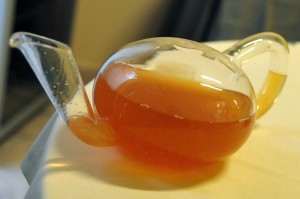
Decanting Orange wines
At the same time its tannic structure and full taste left me perplexed and brought me to talk about this wine for days, without being able to come to conclusions about its quality
Since then I have been more and more curious about this category of wines. Here are some that I have tasted.

Gravner
2005 Gravner “Anfora” (although it seems that Josko does not consider himself a producer of orange wines,) and 2006 Radikon “Oslavje” white, my preferred for complexity and concentration.
2010 Zidarich Malvasia with an intense fruity and floral aroma together with notes of orient spices, tank t the splendid Carso territory and the low yield per plant.
2012 Munjebel “9” white form Cornelissen, a strong connection to the Etna terroir, minerality/sapidity which are exceptional and some unripe tannins which invited me to taste another bottle in a few years time. Matching with food in this case is a must, and a Gargano pasta with octopus, fresh tomato, thyme, parsley, some peperoncino and a drop of white wine complete the masterpiece.
2007 Vodopivec Vitovska, with soft tannins and a creamy structure emphasized by a lively acidity, without forgetting the notes of peaches in syrup, caramel nuts, acacia honey and so forth, and that always present aroma of wet red earth.
2013 Dettori bianco vermentino and Dettori “Renosu”, 2009 Dario Princic “Trebez”.
2012 Didi “Giallo” Sauvignon blanc by Tom Shobbrook, from the Barossa Valley, South Australia. Six weeks maceration on the skins, fermented in third passage barrels, presents silky tannins and oiliness in the mouth balanced by the semi aromatic notes typical to Sauvignon.
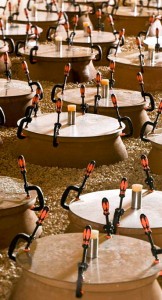
COS anphoras
Undoubtedly the most fascinating aspect of this category is the long history and the total freedom or nearly so, left to the wine, that with its history and origin will evolve like something that is alive.
The skins the seeds and the stems left to ferment in the juice as the famous example of the Georgian qvevri, will leave an imprint in the wine of the soil where the grapes were born, the climate, and man’s hand.
It’s a long story because dating probably back to the 3,150 bc, according to Dr.Patrick McGovern from the University of Pennsylvania, who explains that an Egyptian amphora from then shows some yellow residue together with seeds and skins. This might be the “Yellow” about which Plinio refers when he wrote “wine has four colours …white, yellow, red and black”.
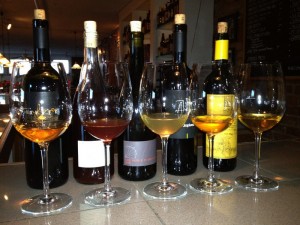
Orange wines
This wine is singular because it continues to evolve in the bottle, some produces encourage more oxidation and some prefer adding sulphur dioxide only for young wines to be put soon on the market, such as Radikon.
According to Radikon the maceration must take place in the presence of indigenous yeasts and without a controller temperature.
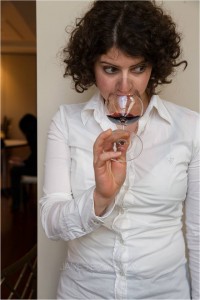
Lisa Cardelli
However the best examples are complex and full of life, with an unexpected combination of aromas and structure- With food the tannins disappear. They are particularly apt for robust tasting food such as aged cheeses or the French Rambol with walnuts, spicy and stewed meats.
.
Read for you by Donatella Cinelli Colombini