








The quality of wine which is not to be consumed
The immaterial elements of wine are worth nearly 2/3 of the perceived value of bottles and are history, territory, packaging, brand, fame, market, price
Seen for you by Donatella Cinelli Colombini

Canelli OICCE immaterial values
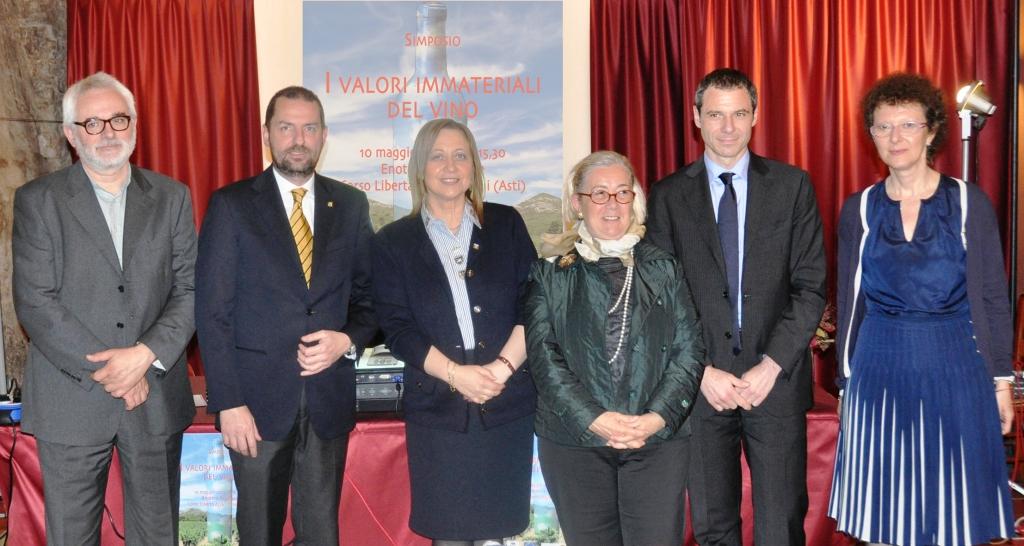
We are in the Enoteca Regionale in Canelli invited by OICCE. Here where the density of the vineyards is maybe the higher than anywhere else in Italy and the wineries Gancia and Riccadonna are part of the historic centre of the village, it is difficult to say, in wine, that fiction beats reality. But it’s true. The value perceived of a bottle goes further than the quality of what it contains. An extraordinary example is the Lafite dated 1787 belonging to Thomas Jefferson sold for 156.000 $. The quality of the wine inside is not so important <<but the bottle’s history is important>> says Giusi Mainardi who teaches wine history in the Università di Torino.
History, but not only. The wine’s territory becomes a protagonist with tourism –

Canelli vineyards spring 2013
and this is where I come into it- or it becomes unique such as the terraces of the heroic viticulture that Gianluca Macchi from Cervim tells us about. Then there is quality that gets told, wine communication, which Fabio Gallo from AIS looks upon with a critical eye <<there is so much of it that wine risks dying through too much communication>>. Then the packaging with so many labels that are works of art that talk about the producers more than words can (Giacomo Bersanetti SGA): the Energy in innovation by Gaja, cultural research by Ceretto, or the elegance by Bellavista. Finally the brands and how they defend themselves especially in nations where they are counterfeited such as Eastern Europe <<but mainly in Italy>> says Maria Cristina Baldini from the Studio Torta.

Canelli Restaurant San Marco Carlo Gardini and Pier Stefano Berta
The creation of a brand is the subject developed through Michele Chiarlo’s testimony <<when as a young man I went to Bourgogne I was surprised by their wines and most of all by their production systems. At that time our Barbera was a wine that with difficulty reached acceptable alcohol levels and did not undergo malolactic fermentation and consequently was tart. I told myself if the Pinot Noir undergoes malolactic fermentation then it must be possible with the Barbera and after several trials I was successful>>
These are the elements for a brand: courage, innovation, tenacity in the increase in quality and a lot of passion. I wish to finish with a detail which seems unrelated but is in truth very important. During the convention Michele Chiarlo was sat next to me. At the beginning of the session his grandchildren arrived – 4-6 years old, no more- who patiently remained waiting for their grandfather to speak. Occasionally Michele gave them a pat, and they stayed in silence until he got up and they began to clap their hand at him with enthusiasm. This too is part of the brand, the continuity in the Chiarlo family.
The trip to Canelli finishes at the table in the San Marco restaurant in front of Fassona beef matched with an extraordinary Barbera chosen by Pier Stefano Berta who with his wife Giusi Mainardi have been dear friends of mine for many many years.