









CASATO PRIME DONNE: A BRUNELLO WINERY—AND MUCH MORE (1)
IF YOU ARE LOOKING FOR A WINERY THAT WILL SURPRISE YOU, COME TO CASATO PRIME DONNE. HERE, I WILL TELL YOU WHAT AWAITS YOU—BEYOND EXCEPTIONAL BRUNELLOS AND UNIQUE EXPERIENCES.
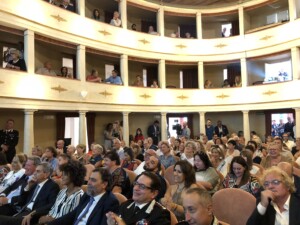
Montalcino 2018 Casato Prime Donne Award with winner Sara Gama
By Donatella Cinelli Colombini, winedestinations, Fattoria del Colle Trequanda, Casato Prime Donne Montalcino
There is a common belief that all wineries are alike. To some extent, this is true, as many do resemble one another; after all, the types of barrels and fermentation tanks used are much the same everywhere. Consequently, architects have sought to arrange them aesthetically to create a “wow factor,” even though this often comes at the expense of winemaking itself. While a uniform row of identical vats may look more harmonious, it is rarely practical to have identical quantities of grapes to fill them. In most cases, winemaking vessels of varying sizes are required to keep grapes from different vineyards, grape varieties, and stages of ripeness separate.
WINERIES MUST EACH TELL THEIR OWN STORY
If you combine the uniformity of wine vessels with the similarity of explanations regarding production processes within a given appellation, you can understand why many visitors decline to visit two wineries in the same area—unless one boasts vastly distinctive features, such as a medieval castle, or has topped Wine Spectator’s “Top 100” list.
During my wine tourism lectures, I enjoy showing images of wineries from a specific region and asking, “Where do you think this is?” In most cases, the answer is “Tuscany,” as it represents the most imitated rural landscape model in the world. Yet, the images are actually from the other side of the globe.
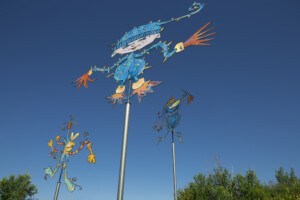
Montalcino Casato Prime Donne 2006 Alessandro Grazi I Gangheretti
For this reason, wineries aiming for tourism success must strive to stand out. Projects by renowned architects are certainly fine; while their work will undoubtedly inspire admiration, it is unlikely to forge the bond of affection, esteem, and shared values that turns a visitor into a loyal customer. The key lies in maintaining a strong connection to the local area and the estate’s history, using this as the backdrop for the wine experience. A prime example is the winery owned by Caterina Dei—whose family is renowned for the stone trade, particularly in travertine. Her winery stands as a cathedral dedicated to both Vino Nobile di Montepulciano and travertine itself.
Another excellent example is Ciacci Piccolomini d’Aragona; its owner, Paolo Bianchini, might well have become a champion cyclist had he not pursued a career as a winemaker. Chairs shaped like bicycle handlebars, memorabilia from great cyclists, photographs—everything speaks of a passion for Brunello and cycling. This is precisely the right approach.
TO CREATE A WINE DESTINATION, YOU MUST MAKE AN AUTHENTIC PLACE UNIQUE.
I have tried to do the same. Casato Prime Donne reflects my convictions: it is the first Italian winery with an all-female staff. It sponsors an award dedicated to female talent. This, combined with a desire to celebrate the pride of Montalcino, translates into a host of engaging experiences for visitors. There are panels recounting historical events, an itinerant tasting accompanied by music… but here I would like to tell you about the “Percorso delle Prime Donne” (The Prime Donne trail).
THE “PRIME DONNE” TRAIL: A JOURNEY TO RENEW THE EYES AND HEART
Each year, the jury of the Casato Prime Donne Award selects a figure capable of inspiring women—and young women in particular. The winner composes a dedication that remains forever in the Brunello region. While some of these messages are truly beautiful and uplifting, they all encourage women to embrace life’s challenges and change. An art installation accompanies each dedication. Initially, these works were created by artists close to Donatella, but the concept of a talent incubator for young people eventually took hold. In essence, the Casato Prime Donne Award serves as a springboard for those with exceptional talent. Young artists, goldsmiths, pastry chefs, receive a boost toward professional success, becoming positive role models for their peers.
The “Percorso delle Prime Donne” (the Prime Donne trail) is a route winding through the Casato Prime Donne winery and vineyards; it offers the chance to enjoy the stunning Val d’Orcia landscape, reflect while reading the dedications, and observe how art installations transform the view by introducing new meanings. Many of these works belong to the “land art” genre, blending seamlessly with the history and landscape. Some are interactive features of the visitor experience, allowing guests to step inside them to take selfies or gain a deeper understanding of Brunello wine and the land where it is produced.
Here, I have selected six of them.
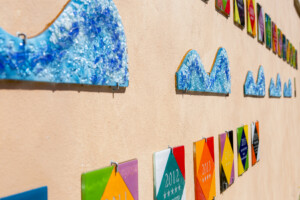
Montalcino Casato Prime Donne- 2008 ACQUA E VINO DI STEFANO CARLUCCI
2008 ACQUA E VINO BY STEFANO CARLUCCI
This installation, located on the exterior wall of the winemaking area, continues to grow over time. Each year, a new tile is created to enrich this “Brunello Calendar,” featuring the stars of the vintage alongside a significant event or company milestone. The waves at the centre pay tribute to the 2008 Prima Donna, Josefa Idem—a canoeing champion and seven-time Olympic medallist who, in 2008, claimed the silver medal, dispelling the common belief that competitive sports are the exclusive domain of the young.
The dedication by Josefa Idem: “Motivation means breaking down mental barriers, overcoming one’s limits, and achieving the ability to express oneself to the fullest; only by putting yourself out there can you discover what you are capable of—even at the risk of failure, it is worth the attempt. It is also because of this mindset that I have the courage to say that nothing is impossible.”