








CASATO PRIME DONNE BECOMES THE SUBJECT OF A UNIVERSITY THESIS
GAIA D’AMBROSIO GRADUATED FROM LUISS WITH A THESIS TITLED “FEMALE LEADERSHIP AND INCLUSION: WHEN DIVERSITY BECOMES STRATEGY. THE CASE OF CASATO PRIME DONNE”

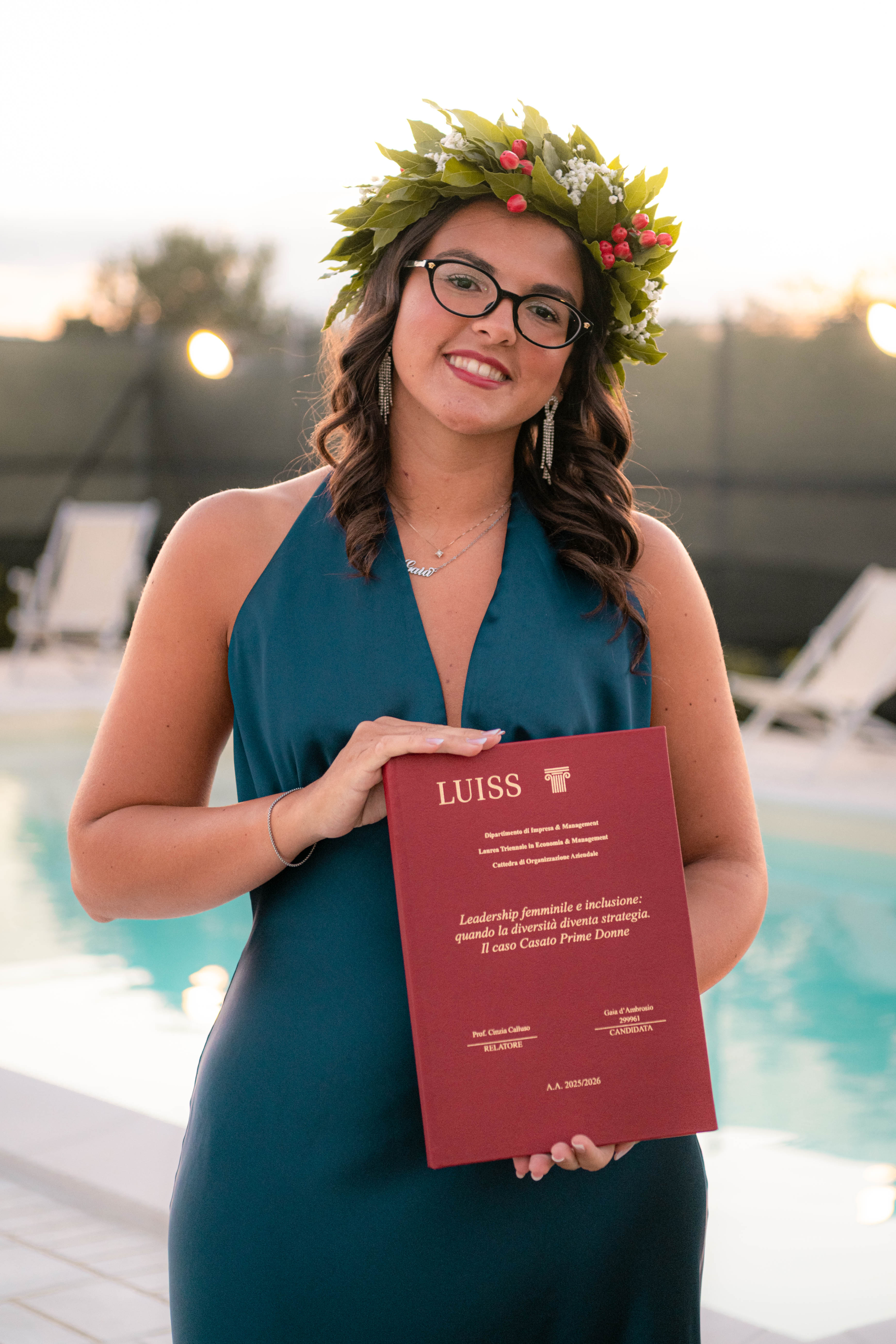
Gaia d’Ambrosio with her thesis regarding Casato Prime Donne
It is gratifying when one’s work inspires others and one’s choices are viewed favourably in an authoritative setting. That is why Gaia d’Ambrosio’s thesis filled us with pride. Gaia earned her Bachelor’s degree in Economics & Management from Luiss University in Rome, with Professor Cinzia Calluso—of the Chair of Business Organization within the Department of Business and Management—serving as her thesis supervisor. Below, I present the final section of her thesis, containing the conclusions.
CONCLUSIONS OF GAIA D’AMBROSIO’S THESIS
This thesis analysed how female leadership and gender diversity can be transformed into a strategic asset. Through a theoretical analysis and an empirical case study of Casato Prime Donne, it became evident that the presence of women in business acts as a tangible driver of innovation, differentiation, and competitiveness. The issue extends beyond mere social equity.
The literature review highlighted that women still face limitations—such as stereotypes, discrimination, and obstacles—in their professional lives. However, the study also revealed advantages associated with female leadership and with models that are more inclusive, collaborative, and relationship-oriented. These dynamics were observed firsthand through the case study of Casato Prime Donne, operating within the traditionally male-dominated wine industry.
FEMALE LEADERSHIP REVITALIZES ORGANIZATIONAL MODELS
Female leadership has the potential to redefine established organizational models and create new forms of value. Over time, what once seemed an “unconventional” choice has evolved into a distinctive trait recognized internationally. When truly leveraged, diversity can transform into organizational identity, innovation, and competitive advantage.
At the same time, this work demonstrates that gender differences must not be reduced to rigid or stereotypical categories. The subject of female leadership cannot be simplified into a mere distinction between men and women. The quality of leadership lies in building relationships, leveraging skills, understanding the context, and driving change.
DIVERSITY AS AN ASSET
In conclusion, this research demonstrates that diversity is an asset to be leveraged rather than a problem to be perceived. Building increasingly innovative, sustainable, and inclusive businesses requires the ability to integrate diverse perspectives, particularly in organizational contexts characterized by high levels of complexity and competition.
Gaia D’Ambrosio