









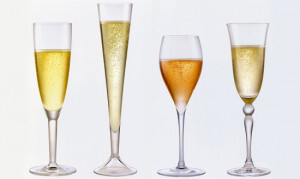
The flûte glass: for or against?
I am among those who hate flûte glasses and also coupe shake ones that fill cabinets taking up loads of space. But many still insist in using them
 By Donatella Cinelli Colombini
Many of us have the coupe shake wine glasses, maybe we have inherited them or we have them as they were a wedding gift received from our mothers or grandmothers. But they have remained in our cabinets unused for decades. <<The size of Madame de Pompadour’s bosom>> the experts used to say, emphasizing the beauty of Luis XV of France’s lover and the fantastic story behind Champagne, that this extraordinary glass should exalt.
This is also the opinion of Marco Cenedese ambassador for Mumm who underlines, how in the coupe,

chateau-Baccarat-
the amber liquid reaches the tip of the tongue before the bubbles thus resulting delicate and full , while in the flûte it gets a drier and more determined character. The tapered wine glass that gets its name from a flute, in French flûte, is the most used Champagne glass but also the most contested. In a recent article in The Drinks Business the CEO for Krug, Maggie Henriquez, made this comparison <<..it is like going to a concert with ear plugs>> . However, in most French bars dedicated to these legendary bubbles, the so called champagneries, they use the typical glasses, ampoule shaped, that look like a flute with a wide and round base. So the flûte has a vast number of estimators. I do not feel that it is able to exalt a fizzy wine, but however together with the cold temperature it can hide the defects in lower quality bottles.

Champagne-flute
So, I do approve of a simplification in the use of glasses and I have noticed that large crystal tableware factories are going in the same direction. A few years ago Chateau Baccarat proposed a long stemmed glass with a coupe with a flat base and sides practically straight, thought out to exalt all wines. On the same wavelength is the revolutionary glass by Luca Bini for Italesse in 3 years of trials. A very versatile glass because it enhances the aromas and the taste of any wine, even though it was born for bubbles.
For Champagne and Spumante I prefer the big tulip, not quite a balloon, but in between a typical glass for whites and the one apt for great reds. With larger shapes I associate a soft entrance into the mouth from the coupe to the better perception of aromas with respect to a flûte.