








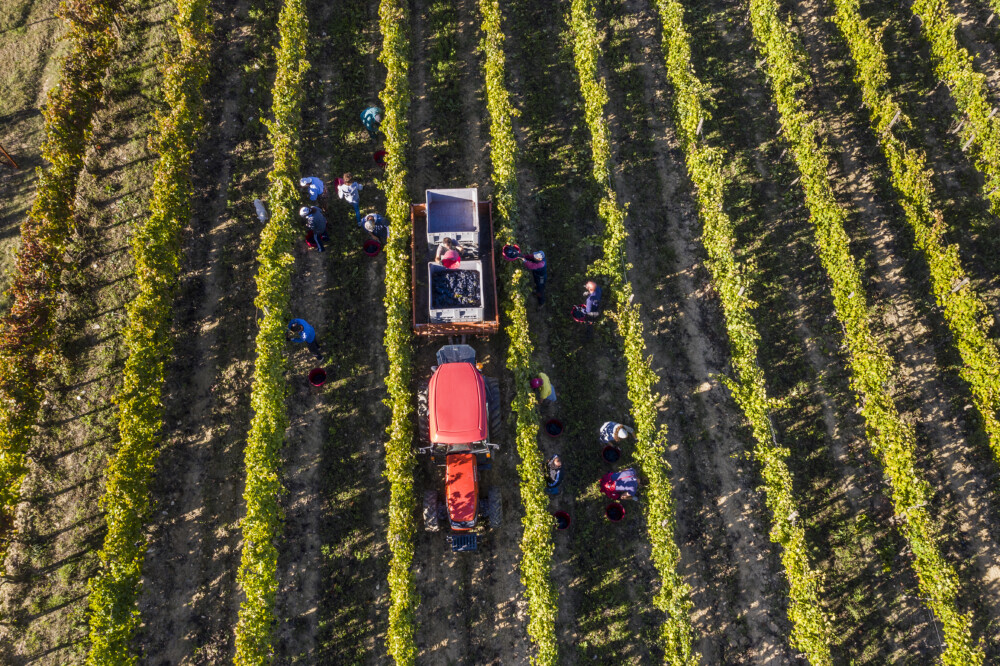
WHO ARE DONATELLA CINELLI COLOMBINI’S GRAPE GROWERS?
EFISIO, DAVIDE, SIMONA, PAOLA, DANIELE, LUCIA, ELIA, KULBIR, MANIJNDER, EMANUELE, SAMIR. SULMAN, ENRICO, NOUREDDINE, AHMED THESE ARE DONATELLA’S GRAPE GROWERS
Grape growers during the harvest Casato Prime Donne Montalcino Donatella Cinelli Colombini
There are fifteen of them, and—with few exceptions—they have been the same for years. The vineyard is the only department within Donatella Cinelli Colombini’s companies where women are in the minority: there are only five. This is because the work requires physical strength and an aptitude for mechanics; indeed, only one woman—Simona De Gregorio—drives the tractor, whereas at least four of the men are able to do so.
A GRAPE GROWER’S WORK IS THE FRUIT OF PRACTICE AND INGENUITY
Years ago, underachieving students were often scolded with the phrase, “If you don’t want to study, go hoe the fields,” implying that agricultural work required no great intelligence—merely the repetition of actions and practices passed down orally.
In short, working on the land was seen as fit only for the bottom of the class. Today, that is no longer the case—or at least, not in viticulture.
The vineyard demands dedication, keen powers of observation, intuition, and study. And this is not just for a short time, but constantly—especially for those aspiring to positions of responsibility.
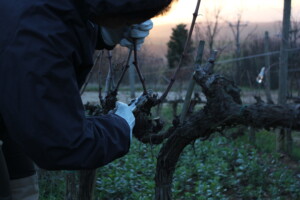
Winter pruning Toscana Montalcino Casato Prime Donne
HOW TO BECOME A GRAPE GROWER
Training a grape grower takes years of practice, and not everyone reaches a high level of proficiency. The learning process is akin to practicing basketball fundamentals: aspiring athletes repeat dribbling, shooting, and passing drills until they can execute them perfectly and automatically, allowing them to focus on the game itself. Similarly, a trainee grape grower learns to prune, trim, and tend the vines alongside an experienced mentor until they can perform these tasks flawlessly and work independently. At the Casato Prime Donne estate in Montalcino and at Fattoria del Colle in Trequanda, Paola Falconi serves as the mentor for new recruits.
In some instances, external training is required—such as the pruning courses offered by Simonit&Sirch, attended by three grape growers who subsequently shared what they had learned with the rest of the team. In other cases, new techniques are introduced by agronomist consultant Gabriele Gadenz. Such changes are becoming increasingly frequent due to rapidly rising temperatures and diminishing soil moisture.
Donatella Cinelli Colombini’s vineyards are cultivated using organic methods, a practice that demands greater dedication and meticulous care.
EFISIO AND DAVIDE: LEADING THE VINEYARD TEAM
The vineyard team was led by Efisio Luche until his retirement, and subsequently by Davide Rinaldi—two extraordinary, passionate grape growers with very different personalities. Efisio is highly skilled in all things electrical, hydraulic, and mechanical, possessing an unerring diagnostic ability when it comes to the vines. Davide is more inquisitive, studious, and experimental—open to change. They still collaborate at times, forming an unbeatable duo. If our vineyards are among the best-tended in Tuscany, the credit goes largely to them: to their ability to spot problems at the slightest sign, their courage in tackling situations to find the best solutions, and the optimism with which they lead the entire vineyard team, making it ever stronger.
Davide’s experimental mindset and the nights he spends reading online have led to the creation of small plots where vines are cultivated using alternative methods. Donatella encourages these experiments—”I like this 18th-century style of empiricism”—because they rely on Davide’s excellent powers of observation and will “surely lead to some wonderful discoveries.”
The craft of the grape grower will change with the advent of artificial intelligence, but it certainly won’t disappear—at least not in those areas where “know-how” and a sensitivity toward nature transform human beings into true masters of their art.