








WHO WE WERE, WHO WE ARE AND WHO WE WILL BE
The dream of producing great wines comes true. Donatella Cinelli Colombini tells of the difficult beginning and the slow creation of a brand with a strong identity
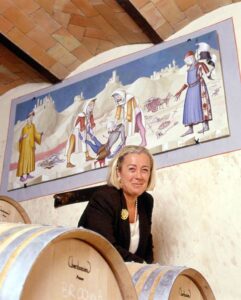
2002 Casato-Prime -Donne-Montalcino-Donatella-Cinelli-Colombini-in-the-cellar
1998-2002 HEROIC YEARS
20 hectares of old vineyard and 5 hectares of new planting on an excavation that unfortunately will have many problems and a short life.
There are no cellars and the wine is held part at the Fattoria dei Barbi and part of it in spaces rented from producer friends.
The production of wine begins with a “dowry” of the future Brunello 1993, 94, 95, 96 and 97
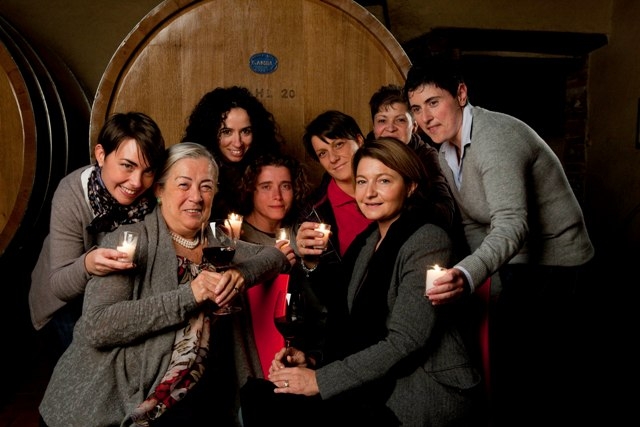
The “Donatella Cinelli Colombini” brand is created, along with the logo and labels of the first wines. The Prime Donne project is born with the winery managed by a female staff, the Brunello selected by a group of female tasters and the Casato Prime Donne award dedicated to the new female role in society and work.
In 2001 the winery of the Fattoria del Colle was inaugurated
In 2002 the Casato Prime Donne winery was inaugurated
Planting of the new vineyards begins: Cenerentola and Pieve at Fattoria del Colle, Ardita and Pero at Casato Prime Donne in Montalcino
Experimentation of the native Foglia Tonda vine starting from 400 grafts from the vitarium of the Regione Toscana
The vines are cultivated in a conventional way, in the cellar there are barrels and barriques. The oenologists are initially Luigino Casagrande and then Fabrizio Ciufoli.
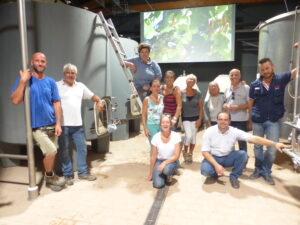
2016- Montalcino-Casato-Prime-Donne-fermentation-room
2002 -2009 THE YEARS OF CARLO FERRINI AND GIOIA CRESTI – WISH FOR THE NEW
The replacement of the old vineyards continues: at the Casato Prime Donne Croce, Croce nuova, at the Fattoria del Colle Cancello Nero, Ristorante and Fondo.
The experimentation of the Sagrantino vine begins with the grafts gifted by Marco Caprai.
The cultivation of the vineyards takes place in a conventional way with integrated pest management. The timing of the harvest depends on the polyphenolic maturation according to the Glorie protocols and delaying the harvest as much as possible. The vinifications are designed to have maximum extraction with pumping over for over 2 volumes per day, délestage and saignée .
The automated sorting table and truncated cone steel vats with punching down mechanism arrive (since 2008) and the experimentation of selected indigenous yeasts (Enobiotech) takes place. The use of 5-hectolitre tonneau begins in the barrel ageing area.
.
2010 -2022 VALERIE LAVIGNE ARRIVES – “BACK TO THE PAST” ATTENTION MOVES FROM THE CELLAR TO THE VINEYARD
Donatella overcomes the “need for discontinuity” that characterized her early years as an entrepreneur and recovers the links with her past in the Montalcino vineyards. A progressive “return to the past” begins following the teaching of grandfather Giovanni Colombini who already wrote “the vineyard dies” in the 1970s denouncing the excessive use of pesticides.
Vineyards
35 ha of vineyards. Year after year the old vineyards are uprooted and replanted after 3 years. The soil of Casato Prime Donne is investigated, with 25 samplings to plan the expansion of the vineyards. Another 4 hectares are planted on the Casato Prime Donne hill and the replanting of the Vignone vineyard begins.
The agronomists are Folco Bencini and subsequently Ruggero Mazzilli.
The grape growers attend Simonit and Sirch‘s courses on pruning.
In 2014 the organic cultivation protocol was adopted and the following year the certification of the conversion begins.
Experimentation of Sanforte with grafts from Badia a Coltibuono.
In the vineyards the espaliers are lowered, winter sowing with green manure is introduced and then integrated with grassing, the topping is reduced and subsequently replaced by cropping, the leaves in September are almost eliminated. Sex traps are used against moths, predators against spider mites, monitoring of phylloxera, preventive actions on sore bait and algae and products based on orange, kaolin to refract light and propolis are used.
In the new vineyards we return to manual planting and more vigorous graft holders, abandoning the 420A. In cultivation we pass from spurred cordon to Guyot. Elimination of plastic ties.
The weather stations are used according to the EPI protocols which allow to predict the arrival and intensity of powdery mildew and downy mildew attacks and thus reduce the use of sulphur and copper.
The post-harvest regeneration interventions of the soil with oxygenators and manure are progressively increasing. With great reluctance they begin the complantations that will give a century-old life to the vineyards.
Grape Harvest
The harvesting technique changes: the calendar is based on the tasting of the grapes and the vines are divided into smaller and smaller plots. The harvest takes place by choosing the bunches one by one and returning several times to the same vineyard in order to put bunches with the same degree of ripeness in the same vat. The number of harvesters rises above 20 to keep the time between the cutting of the bunches and the arrival of the grapes in the vat within 30 minutes. The harvest takes place as soon as the grapes are ready without waiting for over-ripening (generally we are the first to pick in Montalcino).
Cellar
The vinifications are very delicate with the utmost respect for the grapes, a few pumping over and a few punching down of 15 minutes each. Approximately 20 days of closed cap maceration follows. The vinification begins without the addition of yeasts (20%) and the use of pied de cuve.
Interventions on wine are almost limited to just checking.
In 2016 the emptying of the old vat room, the cleansing from industrial yeasts and the arrival of conical vats in bare concrete to contain 50 hl with punching of the cap mechanism takes place. In the barrel rooms the barriques (2010) disappear and progressively the 7 hl tonneau and then the French oak barrels increase. The long experimentation on tonneau allows to identify the 3 most apt tonnellerie.
2021 the restoration and expansion of the Fattoria del Colle cellar with the area for the production of sparkling wine is completed.
The refinement in the bottle is extended.
The imprint of the vine and the terroir is progressively more evident and the style is a “return to the past” with agile, harmonious wines, pleasant to drink even when young and very long-lived.
2023 -2028 FROM BIO TO SUPER BIO
Energy autonomy obtained by increasing the panels and reducing consumption.
Lightweight glass and machinery with lower emissions.
In the organic vineyard, copper and sulphur must be halved through the use of algae and citrus fruits.
New vineyards on more humid and less sunny alluvial soils or on clays with less presence of limestone. Grafting in the field of the new cuttings. Possible thinning of the planting layouts.
Grape sorting with optical reader.
Cellar: expansion and restoration of the Casato Prime Donne Tinaia del vento fermentation area which becomes a closed room with a covered area for the delivery of grapes. Replacement of steel vats with small concrete vats in both cellars. Reduction of aging in wood and increase in the percentage of new large containers in 15 hl French oak. Extension of the living room of the wine in concrete and glass.
Wines: every cellar and every type of wine (aging reds, sparkling wines and sweet wines) must have a small production of excellence in which to invest time, people, research and experimentation, seeking excellence in quality and identity with the utmost respect for the environment. Like high fashion for pret- a -porter. This must give a new philosophy to people and to the company: we must always do better in every detail, even the smallest, more contacts with research centres and constant study.
The bottles produced will remain 170,000 per year but the naturalness, quality and identity will be ever greater.