








Will there be VINE on the earth?
Angelo Gaja tells us his opinion about the effect of global warming in the vineyards. The “Il Corriere vinicolo” summarizes the positions of worldwide experts

Angelo_Gaja
by Donatella Cinelli Colombini
The title is “Ci sarà vite sulla terra?” ( a pun with the word vite that means both vine and life) and in the article one finds a synthesis of the various opinions. Those who own or work in millionaire vineyards tend to deny the effect of the warming to so defend their strong position, while a large slice of the scientific community statesthat the geography of the better territories will change privileging regions that are further North and with more altitude. The replies to climate changes go from empiricism to genetics, but one thing is sure: we cannot lose time and as we cannot change the causes, grape growers must adapt the vineyard by mitigating the climate effects. I am one of the beneficiaries of
Sangiovese vineyard Fattoria del Colle
global warming with Brunello vineyards in the cooler area , this has strongly increase their quality potential thanks to the increase in temperatures but this does not mean that the global problem does not exist.
TROPPO CALDO NEI VIGNETI by Angelo Gaja (november 2015)
The grape growers and the wine producers consider differently the climate that is changing.

Angelo Gaja
The perception of the extremes is general, of the average daily temperatures that are higher, the earlier vegetation process in the vineyard, an acceleration in ripening, earlier grape harvests. Those who look at the benefits state that, compared to the past, great harvests are more frequent. Wines that were once frail and acidic are today more structured and harmonic if not sometimes also muscular. While for others the climate that is changing is an announcement of worries : the recrudescence of parasite illnesses new and old; the suffering of the vineyards because of the long dry periods; grape clusters exposed to sun burning and too bright sun light; the grapes that reach the cellar too hot, with high sugar contents still covered in pesticides as there has been no rain to wash them off; the low acidity of the must; the rising alcohol volume. The climatic changes act s in the same way on the vineyard regardless of its management technique: conventional, biological, biodynamic. A long article in LE MONDE dated November 7th 2015 dedicated to a “heatstroke in the vineyards” underlines great worry
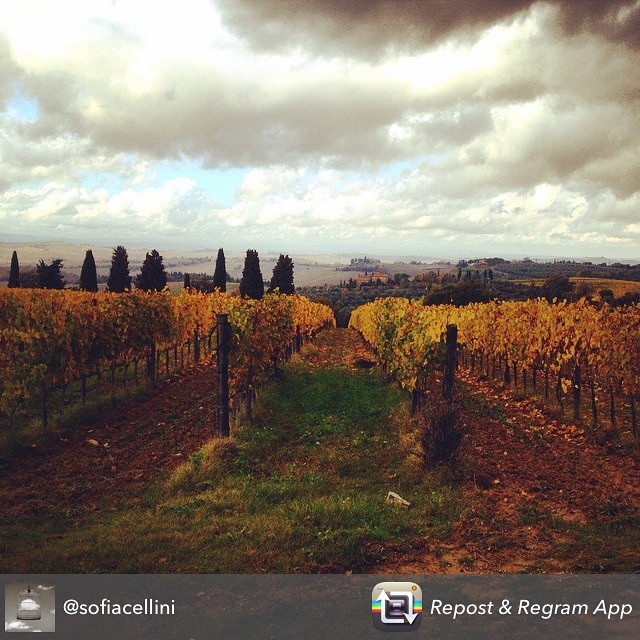
Orcia vineyard in autumn – Fattoria del Colle
about the situation, not only for viticulture in Southern France. The Bordeaux university began about a decade ago research in finding vines that were most apt to combat the changes in climate. It is urgent to send out this message in Italy too: to better the adapting of the rootstock to the changes in climate and to try and save certain historic Italian varieties from some of the most insidious diseases. To do this it is necessary that out nation authorizes researchers to access new crossbreed , cisgenesis and genome editing, through which it is possible to transfer genes from vines that have them to vines that don’t. In this way once again we would make the most of the unique heritage of historical vines in Italy, and so gaining from the diversities which characterize them.
It is though necessary to act now, using both public and private funds. This stalemate situation is not useful to the Italian world of wine.