








Once upon a time when the nuns stayed at Fattoria del Colle
Donatella Cinelli Colombini tells the story of the friars and the nuns sleeping in one of the rooms and apartments of Fattoria del Colle, now destined to tourists for their holidays in Tuscany
Apartment Monache - Fattoria del Colle in Trequanda
Today I would like to tell you the story regarding the apartment which we call “Monache” (nuns) because it once was occupied by the monks and by nuns whose role was to collect charity or alms.
These are the only rooms with railings at the windows, because, as is well explained in the books by Piero Camporesi (Speziali e ciarlatani, Le belle contrade ….), many young monks were frauds who entered the farms so as to empty their pantries. For this reason at night, the monks would be locked in their rooms and could not get out even over the roof. In this way the farmer and his wife could rest properly, knowing that the cheese, eggs, oil and sausages… were well safe. While sorting out the antique wardrobe I found some sheets which had been hand woven with the label saying “corredo delle monache” “nuns’ wardrobe”. They are made of irregular white cotton strips which have been united. I have used them to create some bedcovers for a new “bottom draw”, the one I am preparing for my daughter Violante.
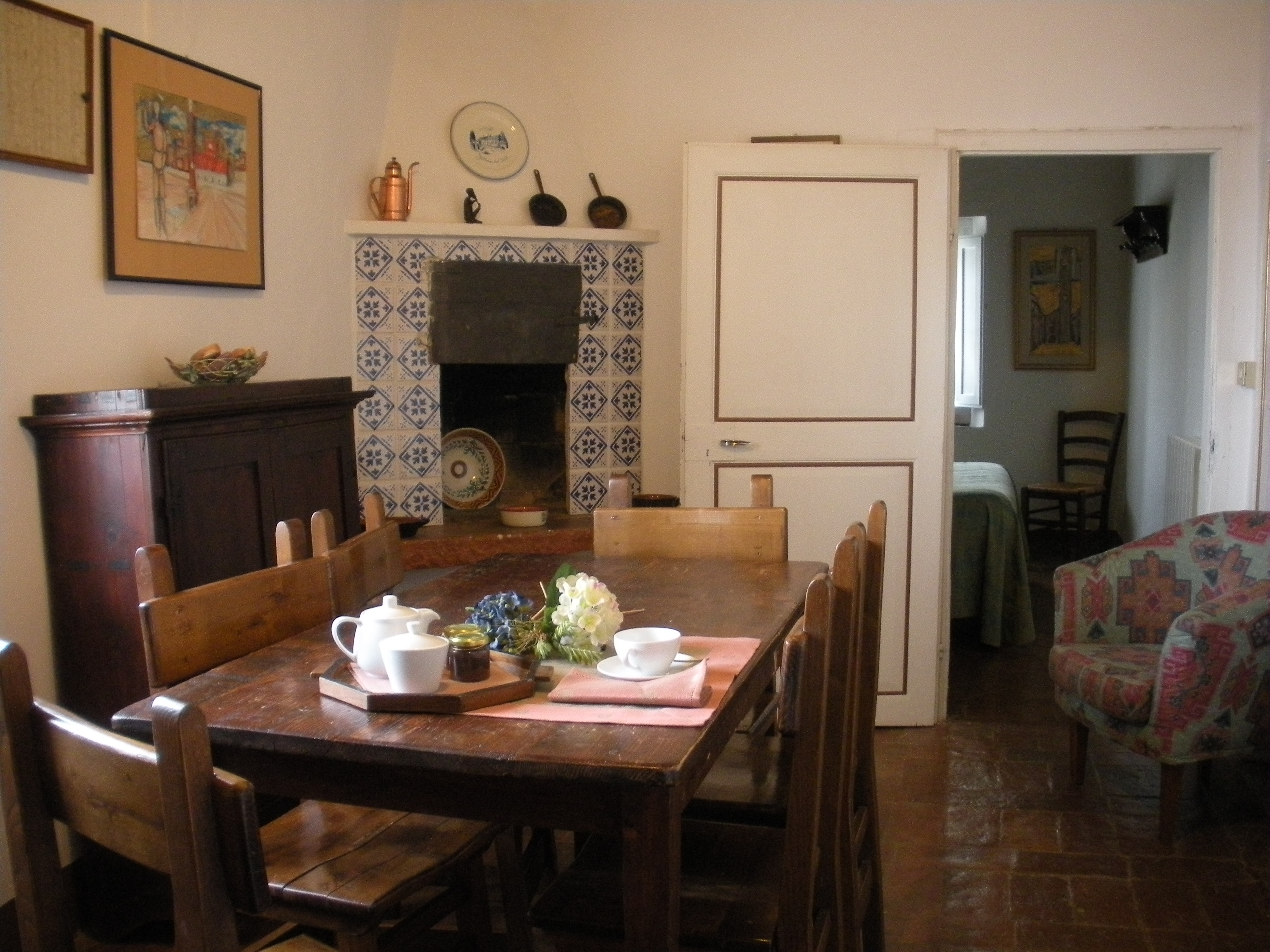
The Monache apartment is on the first floor of the villa and is still tiled with bricks laid in 1592, when Fattoria del Colle was built. In the kitchen there is still a small fireplace in the corner, this was once used by the farmer’s wife to keep the embers for heating her iron. Not far away in fact is the farm’s clothes cupboard, so this kitchen, with its nice light, was the ideal place to iron. Today the irons of various sizes and weights are visible in the big fireplace in my kitchen.
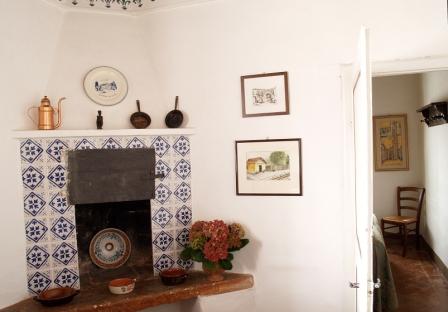
Old fireplace inside the dining room
The double bedroom in the Monache apartment is small but welcoming and well kept, the real nuns bedroom though was the twin one
Wardrobe and chest of draws are original whereas the furnishings for the beds and the curtains have been hand made by Paola, our clever accountant–furnisher.
The bathroom is modern; when the nuns stayed there it would have had a seat with a round hole in the middle where the pot was positioned, this was a white metallic cylinder with a lid. I can remember this smelly little room from my childhood, when the old farmer’s wife used to keep me with her all day long teaching me the stories regarding Trequanda, the small village a few kilometres down the road. It seems such a long time ago, yet, it’s only fifty years.
Donatella Cinelli Colombini