








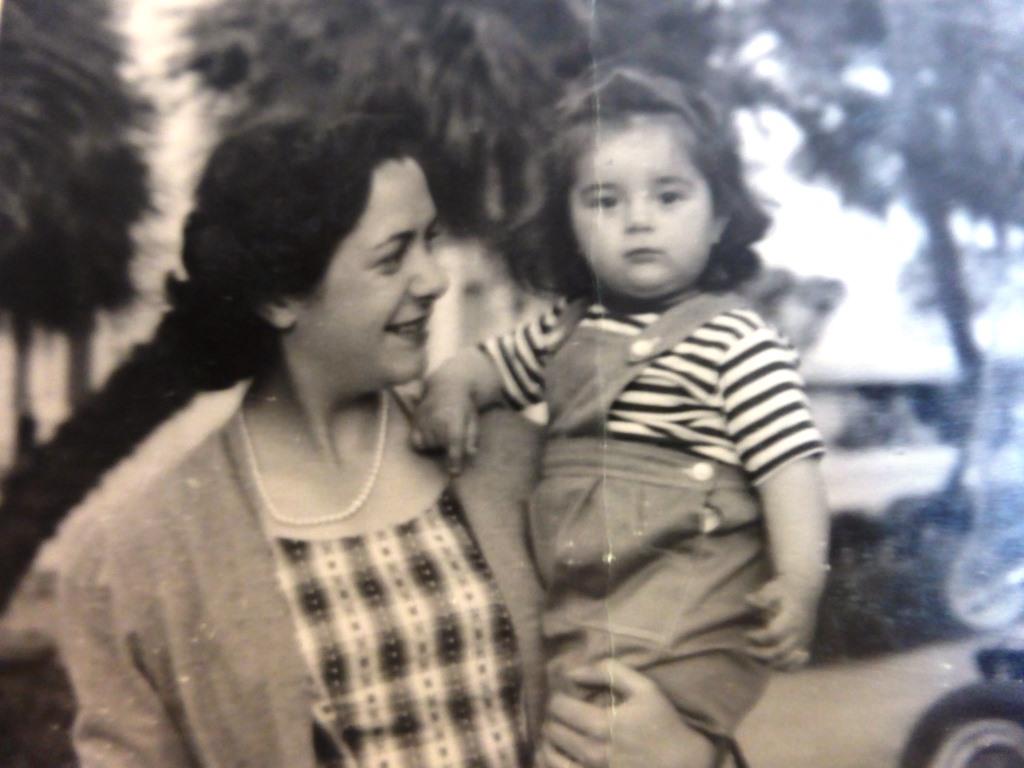
DONATELLA AS A CHILD
I WAS A LONER, A TERRIBLE STUDENT, AND AN AVID READER. I WITNESSED THE TUSCAN COUNTRYSIDE TRANSFORM FROM A STATE OF ABANDONMENT TO A RENAISSANCE DRIVEN BY WINE AND TOURISM
by Donatella Cinelli Colombini, winedestination, Fattoria del Colle Trequanda, Casato Prime Donne Montalcino
Donatella and her mother Francesca Colombini
Many refer to the twentieth century as the “Short Century”—a term coined by British historian Eric Hobsbawm—due to the rapid pace of change; yet, in the early 1960s, it felt as though one were living in a nineteenth-century bubble. It was a world precariously balanced between the lingering past, the economic boom that was emptying the countryside, and social rituals that seemed destined to last forever—only to be swept away by the events of 1968.
As a young girl, I used to spend summers in Montalcino playing with the children of the neighbouring farmers, who would run around barefoot. In winter, back in Florence, boys and girls attended separate classes at the Ponte a Mensola elementary school; we girls wore white smocks with pink bows at our collars. Traffic and crime were low, and we children would walk home alone.
THE SIXTIES: BALANCING FORMALITY AND CHANGE
I remember my grandmother Giuliana’s persistence in teaching my brother and me proper table manners, as well as her silver cutlery—which discouraged my classmates from visiting, as they would complain, “It’s so heavy I can’t eat.” This formal propriety wasn’t limited to my home, Montalcino, or Tuscany. I recall traveling to Valence, in Burgundy, when I was seventeen as part of an exchange program organized by the Siena Rotary Club; at my host family’s home, they would dine in formal evening wear.
Beneath this motionless surface, enormous changes were taking place. At home, too—even though everything seemed the same—money was scarce and debts were mounting. Tuscan farmland had become worthless, and owners were selling it to Sardinian shepherds and farmers from the South; for the price of a single holding back home, these buyers could purchase three here. My parents started a ceramics business that took years to get off the ground, despite their talent and imagination. Instead of selling off the countryside estate, my grandfather sold his houses in Florence and his father’s collection of books and coins to finance his attempts to modernize the farm—raising chickens and veal calves, then pigs, and finally producing Brunello wine.
THE FIGHT TO REMAIN FARMERS IN MONTALCINO
My grandfather was the first to realize the need to reach the end consumer to avoid being crushed by the processing and distribution industries, which were capturing all the profits. He established a dairy to produce Pecorino cheese from his sheep’s milk and a facility to process his pigs into salami and cured meats. He opened a country restaurant—arguably the first of its kind on a working farm—and, above all, ramped up wine production by focusing on importers rather than private customers. It took lion-hearted courage, but it turned him into a national celebrity.
I was dyslexic at a time when no one in my family knew what dyslexia was, so I tackled the problem on my own by forcing myself to read a book a week until I matched my classmates’ speed in reading comprehension. This exercise helped with my writing later on, but naturally, it didn’t solve the problem: using a dictionary remained a huge effort, as did learning English.
A DYSLEXIC AND SOLITARY GIEL, DONATELLA GREW UP BETWEEN MONTALCINO, FLORENCE AND SIENA.
I remained the kind of student who scraped by with a passing grade only by a stroke of luck. Yet, I realized I was better than others at organizing things in terms of space and time; in fact, the more complex the problem, the more effortlessly the solution would appear to me.
I didn’t feel different from my peers, though I certainly wasn’t very sociable. In Siena—where I lived from the age of thirteen through my university years—I had few friends, and most of them were through various associations. In Montalcino, where I spent my summers, I belonged to a *compagnia*—what we would call a “community” today. I didn’t have any real romances before meeting Carlo at eighteen. He was my one great love, even though our relationship had its ups and downs; by the time he won a scholarship to study Italian-Romanian trade and moved to Bucharest for nearly two years, we had broken up, and he had a girlfriend there