








DONATELLA: THE UNCONVENTIONAL WIFE
DONATELLA ASKED HER FUTURE HUBAND TO MARRY HER AND THEY WENT ON TO SHARE A HAPPY MARRIAGE. NINE MONTHS IN LILLE, FRANCE, FOLLOWED BY LIFE IN 9 ITALIAN CITIES.
Wedding Donatella Cinelli Colombini e Carlo Gardini
by Donatella Cinelli Colombini, winedestination, Fattoria del Colle Trequanda, Casato Prime Donne Montalcino
Almost all the best decisions of my life were made on impulse. Including the decision to get married. Carlo Gardini and I had had a solid relationship for years. He had graduated with honours in Economics and Business, then chosen to join the Banca Nazionale del Lavoro, entering a management training program that took him all over Italy to learn about every sector of the business. In 1978, shortly before the August 15th celebration, Carlo called the personnel department to find out his next posting; he was told that, starting October 1st, he was to begin a nine-month stint in Lille, France.
A DECIDEDLY UNCONVENTIONAL MARRIAGE PROPOSAL
“My parents won’t let me come with you,” I said, thinking of the rigid formality of my own home. “We have to get married.” He hadn’t expected it and remarked, “How am I supposed to tell my parents?” The proposal itself had already been unconventional, but Carlo’s reaction went a step further and made me furious. Fortunately, he quickly pulled himself together, and we began a mad dash to get married and leave together. My mother refused to cancel her work commitments, so we were forced to move the wedding to a weekday. It was painful for me; I felt like it was the thing that mattered least to her. It was a frantic, exhausting ordeal.
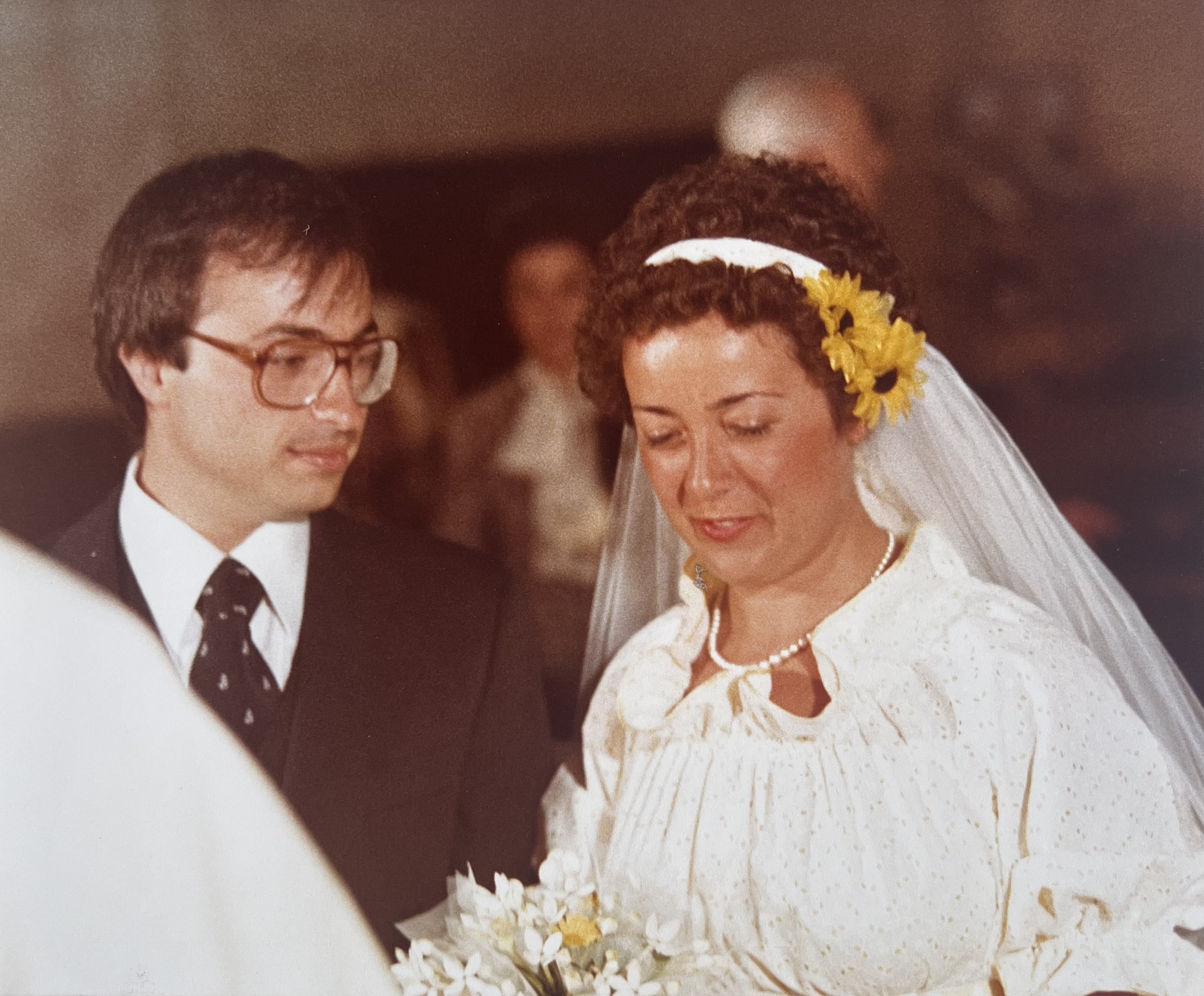
I remember we had the invitations reprinted because of the date change, but then we ran out, so we used the original ones too, correcting the day by hand. Have you ever seen an invitation with a handwritten correction? My dress was very simple—sewn by a seamstress in Montalcino—and had a very “flower child” vibe. We got married in the Oratory of San Bernardino al Prato, which belonged to our parish of Santa Petronilla in Siena. It was an intimate ceremony followed by a lively party with friends.
Our time in Lille, far from our families, allowed us to build a solid relationship. Lille still bore the scars of World War II and was surrounded by coal mines. Once, when I left a window open, I found the house covered in black dust. We had an apartment on Boulevard de la République and many friends—all of them foreigners, just like us. Living abroad and sharing the life of a place that isn’t your own is a strange experience. At first, it’s stimulating, but eventually, it feels depleting because, deep down, the problems you see aren’t yours, and you do nothing to solve them. It’s no different from living in Italy outside your own home region: you feel like an outsider, and you are treated like one.
At first, we spoke English, but later—thanks to university courses (Carlo took the one qualifying him to teach French in non-Francophone countries, while I took the beginners’ course)—we learned French. Lille is the crossroads of Europe because it is close to Paris, London, Brussels, Amsterdam, and Cologne. This allowed us to travel and see a great deal.
THE ITINERANT LIFE OF A BANKER’S WIFE
After returning to Italy, we lived in Padua, Trento, Livorno, Ancona, Sassari, and Venice. These were all short—or very short—stays, except for the last one, which lasted a year. I became an expert at moving house and living in furnished rentals. I was happy everywhere, but the only place I have truly missed is Venice, because its beauty is on an extraordinary scale. The sheer density of beauty and masterpieces, the theatre performances, the lectures… everything in Venice is on a scale beyond the ordinary.
Living as an “accompanying wife” was difficult for me, even though our home was welcoming and we had many friends. Continuing my studies was also a challenge. My university peers were publishing work, while I was increasingly sidelined. Even in Venice—home to a top-tier art history program—the specialized library at the Museo Correr was staffed by librarians who spoke only Venetian; in some instances, an interpreter was actually needed. Yet, at times, I found myself working elbow-to-elbow with Vittorio Sgarbi.
Then my husband Carlo became a functionary, and we were transferred to Reggio Emilia, where we stayed for four years. Continuing my studies there was extremely difficult. I realize that today this might seem hard to grasp, but back then, having a specialized library and a photo archive nearby was essential. The nearest ones were in Parma—where books were catalogued by the year of their first edition, meaning you were stuck if you didn’t remember it—or in Modena, which had the advantage of university professors frequently circulating among the tables and helping even those who, like me, weren’t their students.
DONATELLA AND THE RELIQUARY BUST OF SAINT AGATHA
Among the many intriguing experiences connected to my work studying Sienese goldsmithing, I recall a trip to Catania to see the reliquary bust of Saint Agatha. The saint’s head is the object of intense popular devotion and is kept in the crypt of a chapel, secured behind a gate. It is displayed to the public there twice a year. Monsignor Scalia, the custodian of the relic, allowed my husband and me to remain inside the chapel alongside the officials. It was a surreal scene: the faithful were shouting and calling out to the Saint from outside the gates, while I was touching the bust to take measurements and examine the enamels, shifting aside the jewels that covered it—pieces of immense value, not least because of the importance of the donors who had gifted them.
There was everything imaginable, from the insignia of Richard the Lionheart to the Order of the Golden Fleece. I realized I wouldn’t be able to photograph the translucent enamels on the bust, partly because the silver plaques were curved. Monsignor Scalia reassured me: “This evening, I’ll have a devotee of Saint Agatha come by to take the photos for you.”
That afternoon, a gentleman arrived—whom I took to be a photographer—and he proceeded to take the pictures using a flash, despite my pleas for him to use a completely different method. I was convinced the images would turn out illegible, yet a fortnight later, I received a package containing perfect photos. What was truly incredible was the accompanying note from the Order of Engineers of Catania, gifting me the photographs. I discovered that the man I had taken for a photographer was actually Raffaello Mininni—an engineer and sharpshooting champion who had represented Italy at the Tokyo Olympics.