








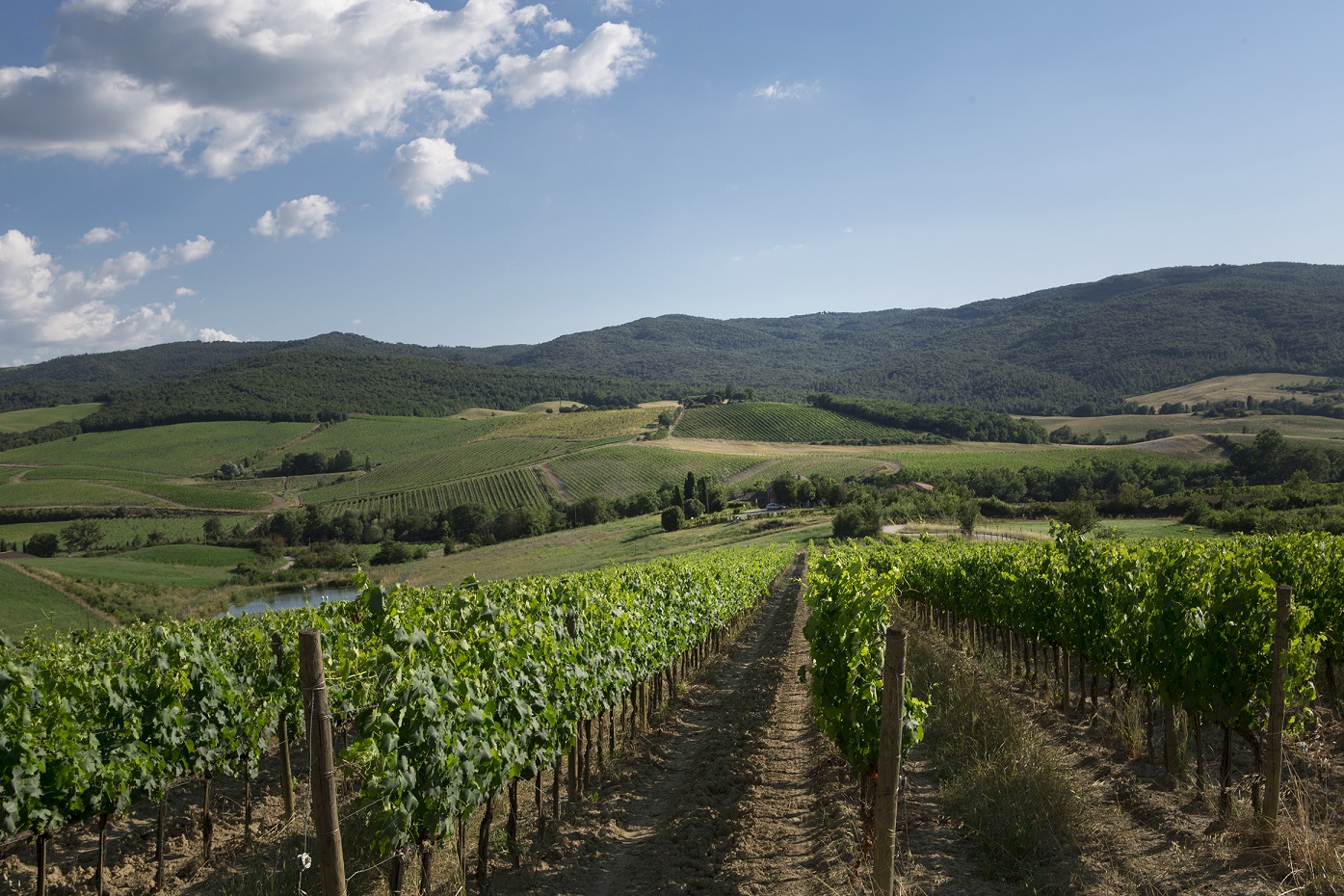
VINEYARDS AT CASATO PRIME DONNE (1)
THE SECRETS OF GREAT VITICULTURE, DRAWN FROM THE FIRSTHAND EXPERIENCE OF A PRODUCER CRAFTING AN EXCEPTIONAL BRUNELLO BY LETTING THE GRAPES DO THE WORK- EVEN AS THE CLIMATE CHANGES
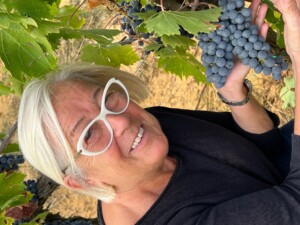
Sangiovese for Brunello Donatella Cinelli Colombini Casato Prime Donne Montalcino vineyards
By Donatella Cinelli Colombini, winedestination
I began managing the vineyards at Fattoria del Colle in Trequanda and Casato Prime Donne in Montalcino in 1998, when my parents gifted me the two estates.
Across the two properties, there were about 25 hectares of old vineyards featuring many dead vines (gaps in the rows) and a multitude of grape varieties and Sangiovese clones—all mixed together and often of poor quality. Unfortunately, it is impossible to restore vineyards in such a state, so I had to uproot and replant them.
I adore centenarian vineyards and envy those who own them. The only old vineyard I managed to save is Sant’Antonio, planted in 1987; it is treated like a relic and tended to with great care… yet it is only forty years old.
I HAVE BEEN PLANTING VINEYARDS FOR 25 YEARS IN THE “GOLDEN CUP” OF BRUNELLO
The remaining vineyards at Casato Prime Donne have been replanted between 2000 and the present day. This process was carried out gradually—planting one or two hectares a year—and relied on a team of excellent vineyard workers led by two extraordinary, passionate “vignerons”: Efisio Luche and Davide Rinaldi. I recall that in 2015, when Denis Dubourdieu—the renowned and formidable professor from the University of Bordeaux’s oenology department—visited us and walked through every single vineyard, he said to Efisio: “Félicitations, vos vignobles sont impeccables.”
Casato Prime Donne is located in the northern Brunello zone, atop a 225-meter hill formed by the fragmentation of the larger Montalcino hill—a process that created the Montosoli rise and, right next to it, our own. In front lies a small valley carved by the Suga stream, which may well have been a river millions of years ago. It is a stunning, cup-shaped area that turns golden yellow after the harvest, thanks to the Sangiovese leaves—a landscape we might well call the “golden cup.”
HOW TO CHOOSE THE SITE FOR A NEW VINEYARD
The approach to selecting sites for new vineyards is changing in response to climate change. In the past, prime sun exposure was the primary factor; today, however, the aim is to avoid excessive sun exposure. Consequently, there has been a renewed appreciation for north-facing vineyards or those located on valley floors, where the soil retains more water.
It isn’t easy for agronomists to change their mindset, and I’ve clashed with them more than once. I would focus on the “unpromising” areas, and they would grimace, saying, “Brunello will never grow there!” We shall see who is right, but it is certainly hard for them to step out of the comfort zone of certainties backed by years of experience, whereas I am always very bold in my decisions.
It was out of this clash of mindsets that the “Sughino” vineyard was born, located near the small Suga stream—now reduced to a mere trickle of water. The vineyard has a gentle slope, which agronomists dislike. It lies in the shade from the early afternoon onwards—another point they disapprove of. Finally, its low-lying position places it in a damper area, raising alarm bells for the technical experts.
WHAT THE EXPERTS PREDICT
Agronomists dislike all its characteristics, yet for that very reason, it should benefit from the new climate—characterized by excessive sun and rainfall that is both scarce and extremely intense. In a few years, we will know whether the vineyard produces grapes capable of yielding Brunellos that are fresh, linear, and elegant—as I desire—or Chiantis that are angular and thin, as they predict. Oenologist Valérie Lavigne has forecast the latter outcome, but I am hopeful she is mistaken.
We currently have a total of 35 hectares of vineyards in production, plus another five that are still being developed. At Casato Prime Donne, the mature vineyards cover 18.49 hectares—all planted with Sangiovese—within a total land area twice that size. My vineyards are all located right around the winery. This is an advantageous setup for vineyard operations and the harvest, yet it carries a huge risk regarding hail; if dark storm clouds were to unleash their destructive force on that specific area, it would be a true disaster.
GUYOT CULTIVATION AND LARGE GRAPEVINE PLANTS
I apologize to those familiar with viticulture, but it is worth clarifying that the grapevine consists of a permanent woody trunk and an annual section that is renewed through winter pruning. In most Brunello vineyards—including my own—the vines are trained using the Guyot system. At one time, the “spurred cordon” method was preferred in Montalcino; while more easily mechanized, it has the drawback of requiring large cuts, thereby making the plants vulnerable to disease. Consequently, the Guyot system offers the advantage of extending the vines’ lifespan.
For me, the goal of maintaining century-old vineyards is a fundamental priority. The complexity of wines produced from very old vines is unparalleled; with this in mind, I purchase about 500 “barbatelloni”—essentially near-mature, vase-grown vines—each year. They are used to replace dead plants, or “missing vines” (fallanze). My vineyard workers dislike this task because the new plants’ roots struggle to find space, and the vines remain stunted for years. Unfortunately, however, it is essential. Vine mortality rates are very high—far higher than in the past. The primary culprit is Esca disease, an infection caused by a mix of fungi that we have only recently managed to treat with a product called Escafix. It is still in the experimental stage, but it works.