Donatella Cinelli Colombini presents her Rosa di tetto 2018 IGT Toscana 2018 for the first time BIO, organic, and for the first time in a “fine wine” version
first harvest with organic certification for Donatella Cinelli Colombini’s wineries and first “Rosa di Tetto” rosé BIO. Our vineyards have always been cultivated with manual care but since 2014 we have begun to follow the protocols and we have begun to be checked on by an external entity that allowed us to obtain the certification and consequently the green leaf, symbol of an organic winery, on the label.
At Fattoria del Colle the production of rosé began more than 30 years ago with the name “Aqua di Tetto”. When Donatella Cinelli Colombini received from her father the farm she decided to change the name because the previous one led to imagine a red wine that had been watered down.

2018-sangiovese-harvest-Fattoria-del-Colle-Toscana
She chose Rosa di Tetto because it recalls the first name buy is also inspired by the climbing roses that grow on the facade of the 16th century villa so high that they get under the roof tiles.
The rosé Rosa di Tetto is produced in limited series of 2,500 bottles obtained through Sangiovese grapes from the vineyards at Fattoria del Colle that were picked and vinified on the estate. So this is a “family wine” or as we would say in Tuscany , “Vino di Fattoria”.
Shopping for more than 253 billion euro per year for wines that cost more than 100 euro and for 12 billion for dream bottles with prices above 1000 euro
By Donatella Cinelli Colombini

luxury-wines-Screaming-eagle-cabernet-sauvignon
During the past few years the high end wine market has increased. It has gone from 77 billion euro in 1995 to 253 billion euro in 2015 (study by Bain & Company in 2016). At the same time, the index of WS auctions showed an increase of 300% in value.
This sort of increase is worthy of the best bonds on stock exchanges and an evident preference of the richer consumers for finer wines.
<<The luxury wine category contains all that is rare and with beautiful aesthetics >> explained Liz Thach, Master of Wine and professor at the Wine Business Institute di Sonoma, to Wine Searcher <<it supplies a sense of privilege and elegance>> in other words those who can buy exclusive and expensive bottles feels privileged and this is something that become quite irresistible.

Luxury-wines-La Tache – Romanée Conti
The book Luxury Wine Marketing by Liz Thach and Peter Yeung studies in fact the desirability of a luxury wine and the elements that make it stand out. In fact, while the market proposes a growing number of extremely expensive bottles, the estate information is quite scarce. This report starts from a database of 8500 wines with a price over $ 100 per bottle, divided per grape variety, region, type and price, and considering the vintages from 2010 to 2016. The main sources used by the authors were Wine Spectator (WS), Wine-Searcher, The Encyclopaedia of Champagne and interviews.
Gender, age, diet, all these affect the quantity of wine one can drink but there is a rigid rule for all: drink small amounts and often to stay healthy
By Donatella Cinelli Colombini

Alcohol-the-after-effect-for women-and-men
Sometimes in the wine world you meet some very unexpected interesting and surprising people, more than one would imagine. This has happened to me this year during the Preview Tuscan tastings when I met the journalist Michael Apstein . He asked me to arrange a visit to the DOC Orcia wineries so that he could write an article for the British wine magazine “Decanter”, only two days beforehand. My husband and I went to pick him up in San Gimignano and in the car I pointed out <you don’t have a British accent> <no> he says <I am from Boston I am a doctor, I thought gastroenterology>. Well, I thought, Boston is where Harvard is and it’s the city of the Nobel prizes , this must be some guy! And in fact when he sent me his article about alcohol consumption I finally understood why doctors say “it depends” when asked what the advised amount is.
The whole article can be found here :https://bit.ly/2SQKqGd
At last, even though of scientific content, it is written so as to be understood by all of us.

Women-and-wine-Violante -in -a wine-tasting
A 80kg male who drinks wine regularly and has just consumed two glasses of wine during a proper meal eaten leisurely over two hours will have a BAC level that is dramatically lower than that of a 60kg woman who drinks only occasionally and has polished off those two glasses quickly without eating.
Scientists have not understood yet why but women break down less alcohol in the stomach, which means that more passes into the small intestine where it is absorbed. The end result is that a woman, despite drinking an equal quantity of alcohol at the same rate as a man, will have a higher BAC
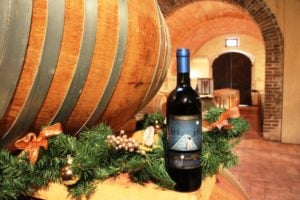
2016, another 5 star vintage, and finally one that is perfect for wines apt for long ageing. Il Drago e le 8 Colombe an auteur bottle for great wine lovers

Il-Drago-e-le-8-Colombe 2016
In 2016 the vegetative cycle of the vines was very very long: the vines budded 15 days sooner than usual, but the harvest took place in October, as was usual traditionally. This was because the ripening of the grapes was gradual and slow: something rare during this era of climatic changes that gave great joy to the producers. In fact the ripening of the grape skin (poliphenolic) and that of the pulp (technological) went hand in hand and this circumstance always produces extremely elegant wines.
This wine was born to celebrate the only man in Donatella Cinelli Colombini’s wineries, my husband Carlo Gardini. These wineries are the first in Italy to be all female staffed. But Carlo is however always present with his advice and his passion for great red wines, that sometimes, are completely different to those that I love.
“Il Drago e le 8 Colombe” was originally “Il Drago e le 7 Colombe” and was renamed with the arrival of our consultant wine maker Valérie Lavigne. On that occasion the blend too was changed, today it is a 60% Sangiovese 20% Merlot and 20% Sagrantino. Three varieties that give different characteristic to the wine: the Sangiovese gives elegance, the Merlot pleasantness, and the Sagrantino increases the structure. All the grapes have been grown on the state, following the organic regime, and are picked, vinified and aged in barrel separately to be assembled before bottling.
This is a small production between 8,000-16,000 bottles per year, a masterpiece. Often this type of wine is called Super Tuscan because although it doesn’t belong to any appellation is aims at high quality, even though with freedom with respect to the rules that are enforced by the DOC appellations. For this reason Donatella Cinelli Colombini has inserted among the varieties for the Il Drago e Le 8 Colombe the Sagrantino, typical variety used in Umbria, its administrative boundary lines, end just about 10 km from the Fattoria del Colle vineyards.
Bianco Sanchimento 2018 from Fattoria del Colle, for the first time BIO (organic). Donatella Cinelli Colombini presents the first products of her environment- friendly choice.
The white wine “Sanchimento” and the rosé “Rosa di Tetto” are the first wines with organic certification produced at Fattoria del Colle. This wine is obtained from grapes from a small vineyard around the chapel of the estate. Its name comes in fact from the patron saint of the small church, Pope Clement I martyr in 97 AD. in Sebastopol. San Chimento is in fact the medieval name given to the same Saint and still today used by the local population.
The small Sanchimento vineyard was planted in 1989 with Traminer grapes on the north side of the hill that goes up behind the chapel at Fattoria del Colle 404 m above sea level. The soil is deep with mostly clay and quaternion deposits.

Sanchimento IGT Toscana 2018
So Sanchimento is a “family wine” obtained through grapes grown on the farm, picked by hand, vinified in a state-of-the-art manner and bottled in a limited production of 2,000 bottles.
The 2018 vintage is particular for its extraordinary aromatic richness thanks to a cool summer and a sunny autumn, but with great diurnal temperature variations.
Why do French wines have higher prices and a higher prestige than ours? How wide is the range? Who are the Brunello lovers in Italy and in the USA?
By Donatella Cinelli Colombini

Benvenuto-Brunello-2019–Nomisma-survey -on-Brunello-lovers
During Benvenuto Brunello, Luciano Ferraro the journalist, presented a survey by Nomisma-WineMonitor regarding prices, markets, and sentiments with respect to French and Italian wines. They used as a comparison method bottles of red wine. To understand the motive for the gap is difficult because the range between the prices is big, and seems to get even bigger, even though in the opinion of the specialized press, and of the best wine critics in the world, it is the other way round.
As I said the Nomisma-WineMonitor study concentrates on bottled red wines, those for which Tuscany is famous all over the world. Let’s start from something already known: at a national level 40% of our expert, equal to 2,5 billion Euros, regards bottles of red and of this number more than half is made up of DOP wines. The problem is that their journey towards success gets slower and slower.
In the last 5 years the increase in exporting of Italian bottled red wine has grown in value by 7% while that of the French counterparts jumped up by 56%. In China they export wine for 686 million Euro and us only 61. If we then look at Hong Kong it’s time to cry: they export 371 million and us 16.

Benvenuto-Brunello-2019–Nomisma-survey -on-Brunello-lovers
Looking at average prices for export of bottled red wines the situation is less dramatic: France 6,09 € per litre, Italy 4,64€. But it is at the high end that this range widens: Burgundy 25,54€ Bordeaux 12,05€ Tuscany 6,89€. It seems that Piedmont is better off with an average price per litre of 9,12€.
This situation is not good for the Tuscan reds, and looking at exports from 2015 to 2017 business has decreased from 552 billion of euro to 427. Veneto and Piedmont have slowed down but they have bubbles like Prosecco and those from the Langhe, while in Tuscany we are not strong on sparkling so we have had a bigger drawback.
Fortunately Switzerland buys the most expensive wines, with respect to any other market and has in fact an average price for importation of 12€ per litre which is very low compared to what it pays for Bordeaux (29,49€) and Burgundies (54,5€) but it is however much more than in the UK where our bottles arrive at 4,5€.
After the 1st position in the TOP 100 by Wine Spectator then the 100 /100 from Robert Parker. The San Guido star shines brighter and brighter

Sassicaia
By Donatella Cinelli Colombini
As well as clever they are very kind, they are humble, they speak and act with extreme simplicity and reserved, as true aristocrats are.
It is in fact the very austerity, elegant in many ways, but where there is no trace of ostentation, that makes the competitors mad, <<how can they have all that success without doing anything at all>>is the surprised comment from all the rest. Hence, a little bit of jealousy , and the word nothing that includes many things: no “shoving” to get to the limelight, no pharaonic events, no self celebrating books, and above all no media overexposure of the bottles or the people …. The only great thing , it seems like, is the increase in value of the bottles and this has been emphasized by Liv-ex the luxury wine portal. A growth, in recent years, that has beaten some of the great French chateaux.

Sassicaia-Priscilla-Incisa-della-Rocchetta-Académie-internationale-du-vin
Sassicaia is born in a winery called Tenuta San Guido and it is a legendary place for many reasons. There is the row of cypresses told of by Nobel Prize winner for literature Giosuè Carducci “ che a Bólgheri alti e schietti van da San Guido in duplice filar, quasi in corsa giganti giovinetti”.
Here one finds the stables Razza Dormello Olgiata, where the super horse Ribot, one of the most prestigious champions of all times.
Also here is the first nature oasis in Italy, created by Mario Incisa della Rocchetta who was also the first president of the WWF.
In this sequence of excellencies one also finds the first wine able to beat French bottles challenging them with their king of varieties Cabernet Sauvignon. It was in 1978, in London, that the wine critic Hugh Johnson, at that time without rivals for fame and authoritativeness. He organizes for the first time for the Decanter magazine a blind tasting of the best 33 Cabernet Sauvignon in the world. And surprisingly the Sassicaia 1975 won.
Zurich is a city of bankers, of luxury that is not on show, the European city where wines costs the most and where I have just been as one of the 255 wineries chosen by Wine Advocate.
By Donatella Cinelli Colombini

Monica-Larner-and-Donatella-Cinelli -Colombini-wine-tasting-WineAdvocate-RobertParker-2019-in-Zurich
In the Wine Advocate -Robert Parker wine tasting the Italian team was the largest, with 53 wineries all along the external perimeter of the hall. For many wineries the owners were present personally. From Montalcino there were 12 of us, 20% of Italian wineries, a very high number that indicates the consideration of Brunello by the most important wine magazine in the world.
The Matter of Taste – fine wine experience reunites 600 excellent wines from all over the world chosen among those that have obtained 90/100 or more from Robert Parker-Wine Advocate. In the tastings you are really spoilt for choice. On the Saturday I concentrate on the Spanish bottles where I find too much oak, although in their opinion this muscular imprint helps them to sell.
I am fascinated by the immense quality potential of the Portuguese and Chilean wines and I am completely taken by the Eolo wine, obtained from a vineyard planted in 1912 in the Trivento winery. Sunday was dedicated to tasting South African wines (where I enjoy a taste of an excellent De Toren 2010) that I know very well thanks to my 6 trips, unsuccessful, to find a partner with whom to create a winery.
I taste around ten Bordeaux remaining impressed by the oak, although well amalgamated, make them apt as “vin de garde” that will remain for years and years in the investors cellars. I pick up again with Champagne and discover a real gem where freshness balance an oxidative stile: it is called Femme (name that makes it very dear to me) and is by Duval LeRoy.

Zurich-sunset-23-february-2019
Then am intrigued to find bottles about which I have written in my blog, like the Argentinean Catena Zapata Malbec with its label full of skeletons and nude women. It’s like meeting up with old friends. And then we find friends in flesh and blood, like Elena Fucci with her husband Andrea, Paolo Bianchini who tells me how he managed to get Alex Zanardi to come to Benvenuto Brunello, Tamara Maccherini who now works for Regaleali
Many of the Wine Advocate-Robert Parker tasters were present including the chief Lisa Perrotti-Brown Master of Wine who is responsible for the Bordeaux and Napa wines. Then Monica Larner, who tastes Italian wines, Stephan Reinhardt, reviewer for Switzerland, Champagne, Loire, Germany, Alsace, and Austria, and William Kelley, taster for Burgundy.
They consequently guide stellar master classes. What is stunning is their young age: Reinhart with his total white hair has a handsome face that makes him similar to an actor or a model, Kelley looks like a teenager and is described by Monica Larner as a genius with a prodigious memory because he can quote without hesitation the vertical tastings of all the wineries.
Calaf, the prince in the Turandot by Puccini, gives its name to the dark chocolate pralines containing drops fine wines such as our Brunello

Calaf-e-Brunello-DonatellaCinelliClombini
Calaf is a series of 9 pralines in dark chocolate filled with drops of Brunello, Amarone, Fiano di Avellino, Passerina del Frusinate, Malvasia, Passito di Pantelleria, Primitivo and Taurasi. Obviously the Brunello is one produced by Donatella Cinelli Colombini.
Every bon bon is packaged, as if it were a jewel, in single boxes, or in a box set that contains the whole series of 9-18 chocolates. On the outside there are drawings from the beginning of the 20th century, a clear exotic inspiration that recalls the protagonist of the Turandot. Calaf is in fact a Chinese prince that succeeds in transforming into a woman in love, the beautiful but bloodthirsty Princess called Turandot. This old fable became famous because of the music written by Giacomo Puccini and never finished by the composer because of his passing. For this reason, during the first performance in (1926) at the Teatro Alla Scala, the Maestro Toscanini interrupted the representation at the point where the composer had left it, and refused, even in later occasions to perform the completed version by Franco Alfano.

Calaf-praline-with-Brunello
So Calaf is a love hero. He who puts his life at risk to have the woman he loves. And it is this romantic character that Nadia Pagliuca, born in Campania but now living in Tuscany that inspired her to create a high end series of exclusive chocolates.
To open her boxes is an aromatic experience even before becoming a taste experience, because the aroma of the bon bons is so intoxicating. Each box can per personalized and become a present unlike any other.
Calaf is the second of Nadia’s projects in Tuscany. In 2012 she opened “La Confetteria Firenze” with the support of a famous confectioner from Sulmona. Here, in this partnership, the first Chianti filled bon bon was born, and inevitably it became a constant presence at weddings in Tuscany. The new Calaf project regards Nadia Pagliuca together with a group of family members and friends with whom a series of pralines, where chocolate and fine wines are mixed, has been studied and tested.
Forum regarding the old grape variety called Foglia Tonda with wines from 9 wineries. Donatella Cinelli Colombini and Gianni Fabrizio tell the story and the characteristics

Foglia-Tonda-Donatella-Cinelli-Colombini
On Friday February the 1st at Fattoria del Colle, in Southern Tuscany, the Foglia Tonda grape variety will make its debut into wine society, where there is a comparison between great winemaking in front of great wine critics. Donatella Cinelli Colombini, host and initiator of the rediscovery of this old Sienese grape variety abandoned more than 100 years ago and now once again of interest to the market and to the experts. She together with another 8 colleagues will tell the story and give a tasting of wines based on Foglia Tonda variety.
<<We found 18 wineries producing Foglia Tonda and 9 of them, from all over Tuscany have replied to our invitation. The forum allows a group of experts and influencers to get to know the Foglia Tonda characteristics better, within its terroir and style differences>>explained the famous taster and journalist Gianni Fabrizio. He will guide the tasting of three of the wines presents obtained with only Foglia Tonda , where some aged in an amphora will give the possibility of better understanding the fruit, ad two blends will give the possibility to consider the potential of Foglia Tonda as a partner for Sangiovese, main variety in Tuscany. The other 4 wines will be served directly by their producers with an around the table setting.

Foglia-tonda-forum-2019
Podere Sequerciani (Gavorrano GR), Podere Ema (Grassina FI), Mocine (Asciano SI), Il Castellaccio (Castagneto Carducci LI), Donatella Cinelli Colombini Az.Agr. (Trequanda SI), Mammuccini Droandi Nuova Agricoltura (Montevarchi AR), Podere Anima Mondi (Casciana Terme PI), Santa Vittoria (Foiano della Chiana AR), Poggio al Vento Mascelloni (Castiglion d’Orcia SI).
2013 was a vintage that started low key, and that later convinced experts and consumers all over the world. In the Riserva versions it aims to get to the top of the ratings

2013 harvest Annibale the dog
This had already happened in the past when the 2009 bettered all expectations and so became one of the cult vintages for Brunello.
The 2013 vintage had a rainy winter and a cool summer, a typical climate for long lasting and important Brunello. Shortly after the harvest the wine did not seem so special but after the time spent in barrel it finally revealed its extraordinary elegance.
To understand what happened let me tell you how the stars get awarded to Brunello vintages. Long ago the evaluation of vintages was done by expert wine journalists but in 1992 the Consorzio del Brunello decided to do it itself, with rigorous and above all objective criteria. From that moment onwards, every year, its asks the Montalcino wineries, for a sample of the new vintage just born. It has all samples analysed and then reunites a panel of technicians made up of the best wine makers. Their opinion is expressed in stars: 1 star for a bad year, 5 stars for the excellent ones.
During the presentation of the new Brunello, half way through February, the President of the Consorzio reveals the number of stars that have been attributed to the new vintage. This rating is portrayed on a ceramic tile positioned, each year, on the facade of the Old Town Hall in Montalcino and also on our fermentation room facade at Casato Prime Donne.

Harvest-Brunello-2013-sorting-table
This method has been criticized during past years; the amount of 5 stars vintages has increased greatly with the climate changes, and some vintages, especially after barrel ageing, reveal qualities that are much
superior to the expectations.
This is exactly the case of the 2013 vintage, that obtained at the time just 4 stars. But after its barrel ageing it has been judged, by many of the best tasters, as superior to the 2012, that in fact had had a better rating.
There is a widespread habit of writing on the label an alcohol content percentage that is not quite exact but closest to the value considered ideal for high quality wines. Let see who puts the true or false alcohol content on the label

Chilean vineyards
By Donatella Cinelli Colombini, Montalcino, Casato Prime Donne
The most sincere are le Portuguese, those that cheat the most are the Chileans for red wines and Canadians for whites
What is surprising is that this trick regards only wines on sale at more than 40$. But, in order; this information had worldwide coverage thanks to Wine Searcher but originally came from the Journal of Wine Economics which published a study regarding 91.000 analysis carried out by LCBO Liquor Control Board of Ontario. In other words it was the state monopoly for the sales of alcohol in Ontario to do the study.

Malbec Argentina
Sweet wines and Rieslings were not included.
The LCBO analyzes all the wines that it distributes and in the course of 18 years has collected a data bank without competitors in the world. This information allowed Julian Alston, Kate Fuller, James Lapsley, George Soleas and Kabir Tumber, to get these very surprising results.