




What do you want to book?


Forum: News and lifestyle

Calici di stelle at Fattoria del Colle

Make a wish on the magical Cenerentola terrace on August 5th. For Calici di Stelle at Fattoria del Colle great wines, typical dishes and live music


Violante-Gardini-Calici-di-stelle-2016

Violante-Gardini-Calici-di-stelle-

The appointment with the shooting stars, the great wines and the live music by Andrea Pinsuti is set for August 5th at 7 pm at the Fattoria del Colle.


AUGUST 5 WITH A VISIT FULL OF SURPRISES, TYPICAL DISHES, GREAT WINES AND LIVE MUSIC

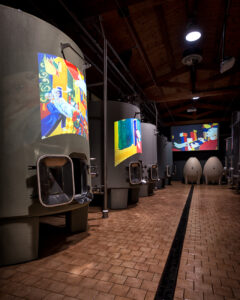
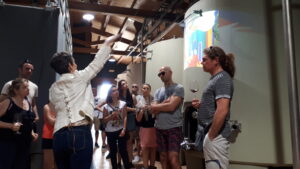
Welcoming with a glass of wine and then a guided tour full of small exciting surprises: the vegetable garden with Tuscan wild herbs to smell and taste preparing to then savour them again for dinner. Then the visit to the cellar with the Cenerentola mural painted by Silvia Argilli, which tells of the marriage between Sangiovese and Foglia Tonda.

Calici di stelle Fattoria del Colle

Calici di stelle Fattoria del Colle

There is the new room that teaches you to listen to the vineyards, and the signature on the barrel of desires on the new terrace with the spectacular corten railing created by Elisa Boldi inspired by the winter oak woods in Valdorcia.


FATTORIA DEL COLLE MAGIC FOR CALICI DI STELLE 2021

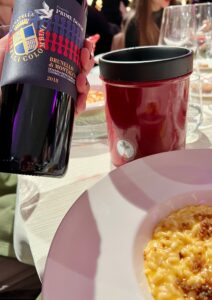
At 8.00 pm  the real party begins with a buffet of Tuscan specialties prepared by chef Doriana Marchi: Panzanella with ancient Tuscan wild herbs, pasta with sugo bugiardo, mixed meat stew with potatoes cooked under the ashes, caffè in forchetta and whipped ricotta. All accompanied by a glass of Leone Rosso Orcia Doc or Sanchimento Supertuscan Bianco IGT 2020. For wine lovers the range of wines will expand to Brunello, Supertuscan, Cenerentola Doc Orcia and other award-winning wines in Italy and abroad with very high ratings.


WINE TOURISM BY MOTORBIKE

Motorbikes, Vespas and bicycles …. Travelling through the wine regions on two wheels has become a way to breathe, feel free and immerge in nature


By Donatella Cinelli Colombini

The Giro d’Italia has crossed the Doc Orcia and Brunello territories using dirt track in the middle of the vineyards and creating images and emotions that have made their way into the hearts of bicycle enthusiasts from all over the world. Shortly after, still in Montalcino, the Eroica called upon the Italian and foreign cyclists most attracted by memorable feats and the magic repeated itself. The harmony of the most beautiful agricultural landscape on the planet, which since 2004 has been protected by UNESCO as a World Heritage Site, transforms outdoor cycling into a regenerating and rewarding experience.

The effect of this countryside, cared for millennia by the hand of man, is a sense of well-being of body and mind that psychologists call “landscape therapy”. It calms, and invigorates with a feeling similar to that described by Giacomo Leopardi in his Infinito: << mirando, interminati/ spazi di là da quella, e sovrumani/ silenzi, e profondissima quiete ….. tra questa/ immensità s’annega il pensier mio:/e il naufragar m’è dolce in questo mare>>
<< aiming, endless / spaces beyond that, and superhuman / silences, and very deep stillness ….. between this / immensity drowns my thought:/ and to be  shipwrecked in this sea is sweet to me>>.


WINE TOURISM BY BIKE, MOTORBIKE AND VESPA

Of course, not everyone loves cycling, there are those who prefer walking, those who run along dirt paths, or motorcyclists and Vespa tour lovers, but everyone is looking for a more direct contact with nature and the territory outside the car with its comfortable air conditioning and isolation, even from sound, from the surrounding environment.
For them the Valdorcia and the Crete Senesi are an ideal destination that combines landscape beauty, culture and food and wine pleasures.


Zuppa di pane di Dante, a fourteenth-century flavour

In the occasion of the seven hundred years since Dante’s death, the restaurant at Fattoria del Colle will serve this Tuscan fourteenth-century bread and vegetable soup. You will taste the Middle Ages


Zuppa-di-pane-di-Dante-Fattoria-del-Colle-Doriana-Marchi-Donatella-Cinelli-Colombini

Zuppa-di-pane-di-Dante-Fattoria-del-Colle-Doriana-Marchi-Donatella-Cinelli-Colombini

By Donatella Cinelli Colombini

Beans, autochthonous Tuscan plants that the expert botanist Caterina Cardia has planted in the vegetable garden at Fattoria del Colle, as well as onions form Certaldo, extra virgin olive oil form our olive groves and home baked bread by our chef Doriana Marchi with sourdough…. All to create a soup similar to what Dante would have eaten in 1300. That year the supreme poet went to Rome along the Via Francigena which, in the southern section of Siena, crosses the Valdorcia. Wanderers stopped to sleep in the Spedali along the way. They prayed and consumed very simple dinners based on local dishes.


A SOUP THAT TEACHES MEDIEVAL HISTORY

Bread soups with beans and vegetables were typical of the countryside and Dante certainly ate them very often. In the Trequanda area, about 20 km from the via Francigena, bread soups were enriched with a few pieces of pork as the housewives still do today.

However Dante’s bread soup at Fattoria del Colle is certainly better than the one that fed the supreme poet on the long journey to Rome but the ingredients are almost the same. For this reason we can consider savouring this soup a cultural experience even more than a gastronomic one: a direct knowledge of the Tuscan Middle Ages.


INGREDIENTS FOR THE ZUPPA DI PANE DI DANTE

Half a kilo of black-eyed beans, a Certaldo onion, a large slice of prosciutto and one slice of salted Tuscan rigatino, bread made with sourdough, half a glass of extra virgin olive oil, kale, chard, stork, other Tuscan wild herbs, parsley, salt and black pepper.


TRADITION ATTRACTS VISITORS AND CUSTOMERS MORE THAN INNOVATION

Which wineries attract wine tourists the most? Do they like more traditional food or that of technologically advanced companies?


Farmhouse food beats technologically advanced food

Farmhouse food beats technologically advanced food

by Donatella Cinelli Colombini

Many will answer <<famous wineries>> and it is true. Wine super brands are strong magnets for wine lovers. But among the various types of wineries it is not the masterpieces of the archistars or the giant and innovative creations that enter the hearts of visitors but the boutique cellars where everything speaks of the producer’s passion in grasping the magic of nature transforming it into unique nectar different from any other.


FARMHOUSE FOOD BEATS TECHNOLOGICALLY ADVANCED FOOD

Tradition and manual care are the most appreciated things. If you ask the wine tour guides they will tell you that if visitors see the producer come out of the vineyard dirty with soil to welcome them … that’s it, customers will fall in love with him.

tradition and manual care win on technology in front of turists' eyes. Violante Cinelli Colombini in the Brunello vineyard.

tradition and manual care win on technology in front of turists’ eyes. Violante Cinelli Colombini in the Brunello vineyard.

For this reason it is always better to begin the guided tour of the winery from the barrel ageing area rather than from the areas where steel and technology are the protagonists, such as the fermentation room or the packaging area.

In fact, already in her second Report on Food and Wine Tourism Roberta Garibaldi noted that the charm exercised by ancient traditions was an element capable of standing out above others: in her survey, the greatest increases in interest were recorded in historic restaurants and cafes, the tasting of typical dishes in their area of origin.
All trends that have been amplified by the epidemic, the lockdown and forced quarantine in the city. The Nomisma-UniCredit Tourism Observatory, in partnership between Enit for the “Made4Italy” project, has highlighted the growing importance of the “Food experience” during a trip and how it is increasingly linked to the territory, culture and local traditions. For this reason, 28% of the hospitality facilities are preparing food and wine tours on the territory to allow tourists to enter typical wineries and food workshops while 24% will offer menus based on local products and raw materials “farm to table”.


AGRICOLTURE AND WINE BETWEEN TRADITION AND INNOVATION

Agriculture and wine in Europe face great challenges: green-deal, next generation, Farm to Fork, Biodiversity … innovation is an obligatory path but they must remain faithful to themselves and to their roots if they do not want to lose charm and customers.
The Nomisma-Agrifood Monitor survey in collaboration with Crif shows us how 45% of Italians perceive the agri-food products of “traditional” companies as superior to those of technologically advanced companies. There is even an 18% willing to pay more in order to have genuine farm food. But at the same time a majority share of consumers (54%) calls for agriculture to take a step forward in the name of sustainability and therefore of innovation.


DOPOBARBA DELLA TITA FROM FARMACIA SALVIONI

Two stories from Montalcino, one about the Farmacia Salvioni that starts in 1499 and one about La Tita that tells of post war times, first in UK and then in the Brunello gardens, and a dedicated aftershave, il dopobarba della Tita


Roberto and Fabio Salvioni in their pharmacy in Montalcino

Roberto and Fabio Salvioni in their pharmacy in Montalcino

by Donatella Cinelli Colombini

What binds theses two stories that tell of the true spirit of the Brunello town, is the Dopobarba della Tita (Tita’s aftershave) that the Farmacia Salvioni has created among its cosmetic production range, as it has been done for centuries in the old dispensaries, to dedicate it to their most faithful client.

It seems like something normal but instead the story contains an old and noble tale.


THE FARMACIA SALVIONI AND ITS HISTORY SINCE 1499

The Farmacia Salvioni is in the old market square in Montalcino next to the Loggia, where vases, copper objects, vegetables, chicken and grains were sold.

Farmacia Salvioni in Montalcino: Dopobarba della Tita (Tita’s aftershave)

Farmacia Salvioni in Montalcino: Dopobarba della Tita (Tita’s aftershave)

In 1499 in those 4 rooms used still today, Paolo Dei and Giacomo Marzuoli <<ilcinenses aromatarios in civitate ilcinea>>, were apothecaries, in other words pharmacists.

At the beginning of the 17th century the dispensary in the square changes hands it goes from the Tinelli family to the Angelini family and is active in the production of therapeutic preparations and of spices to cook with: pepper, almonds, isinglass …  but also cakes such as pan pepato, copate and biricoccoli.

At the beginning of the 18th century the pharmacy changes hands several times until it is donated to the Ospedale di S. Maria della Croce who entrusts it to the young pharmacist Clemente Santi who later became the owner. The beautiful bronze mortar dated 1751 and with the coat of arms of S. Maria della Croce, still today proudly on show comes from that period.

In 1814 in the pharmacy we find his grandson, he too called Clemente Santi, with a degree in pharmacy from the University of Pisa where Giorgio Santi teaches natural history and has a fantastic reputation. Clemente was intellectual, very dynamic and with historic-artistic interests as well as agricultural ones, corresponds with the Accademia dei Georgofili, collaborates with the Giornale Agrario Toscano and can be considered one of the “founders” of the Brunello wine and of the Biondi Santi family.


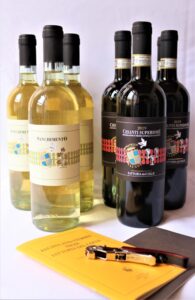
Sanchimento IGT Toscana Bianco 2020

The IGT Toscana Bianco Sanchimento is a small masterpiece of creativity and respect for nature. A white Supertuscan in meaning exclusive, innovative BIO (organic) and slightly orange style


Sanchimento IGT Toscana 2020 - supertuscan from Fattoria del Colle

Sanchimento IGT Toscana 2020 – supertuscan from Fattoria del Colle

This Sanchimento is obtained with the first grapes picked by the “masked pickers” which means those wearing the anti-Covid masks!!

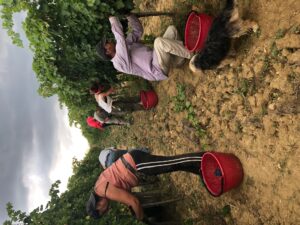
Everybody will remember the 2020 grape harvest at Fattoria del Colle for the difficulty in following the safety rules regardless of the heat, fatigue and not being able to breathe properly. But nobody was infected let’s hope it will be the only grape harvest under the Covid claws.


SANCHIMENTO A BIO SUPERTUSCAN

The Traminer grapes were handpicked; the clusters were cooled in an old IVECO refrigerated truck. It is an antique but we keep it to use just for the grape harvest.

After a first experimentation in 2019, the cellar master Barbara Magnani with the two junior wine makers Sabrina and Giada launched themselves into a very interesting chemistry between traditional vinification and orange wine.

Sanchimento IGT Toscana 2020 - Supertuscan - Fattoria del Colle

Sanchimento IGT Toscana 2020 – Supertuscan – Fattoria del Colle

Part of the grapes was in fact vinified with the skins and with autochthonous yeasts. The blend with the Sanchimento vinified traditionally took place before bottling. The result is a wine of great character and finesse, less aromatic than before but more complex on the nose. More agile, full and structured on the palate. A wine that is not ordinary that demonstrates courage in experimentation and interprets the natural characteristics of the Traminer grapes grown in Tuscany.

The small Sanchimento vineyard was planted in 1989 by Fausto Cinelli, Donatella Cinelli Colombini’s father. It surrounds the San Clemente chapel at Fattoria del Colle. Chimento is in fact the name that was used locally instead of Clemente in the tongue that then became Sienese vernacular.
IGT Toscana Sanchimento 2020 is consequently a BIO Supertuscan produced in a small series of 2000 bottles. An exclusive wine for wine lovers that will visit or stay at Fattoria del Colle in 2021.


Gabriele Gorelli the first Italian Master of Wine

He is from Montalcino a polyglot, kind, intelligent, a great worker and communicator, he knows and understands wine … the first Italian Master of Wine Gabriele Gorelli


Brookshow and Gorelli Brunello nel cuore book

Brookshow – Gabriele Gorelli, Donatella Cinelli Colombini, Fabrizio Bindocci: book “Brunello nel cuore”

by Donatella Cinelli Colombini

Upon receiving the message of congratulations from Violante and me he replies <<Dear friends, I know you have always believed strongly in me. This encourages me and makes me proud of the Tuscan and Italian entrepreneurial structure. It has been difficult, very difficult. I still cannot believe it … Thank you so much , G.>> Just a few words that transmit the great tension, still not assimilated, with respect to a trail that has been demanding more than expected and the subsequent great emotion. Practically under shock, for the success, chased for 5 years and that all of Italy has been waiting for, for at least thirty.


ITALIAN WINE EXPERTS WHO HAVE DIFFICULTY IN ESTABLISHING THEMSELVES BY REMAINING IN THEIR HOMELAND

It really seemed like a running joke, among the 418 Master of Wine there were wine experts from 32 nations but nobody from Italy. Practically a stamp of our wine provincialism manifested far too often: let us remember the embarrassing occasion of the tem contest for sommeliers on October 12th 2019 at the Castle of Chambord in France, where our team were last out of 27 nations taking part. Two times in a row this happened.

Benvenuto Brunello: the ceremony behind the scenes with Gabriele Gorelli

Benvenuto Brunello: the ceremony behind the scenes with Gabriele Gorelli

Our wine experts are technically very strong and when they go abroad they are like fireworks. Think of Matteo Montone, from Milan living in London who won the title of Best Young Sommelier in the World in 2019 and, last summer became part of the Court of Master Sommelier. In this association too there are 267 members from all over the world, only two are Italians, both work abroad though.
The most sensational case however is Paolo Basso who won the title of Best Sommelier in the World ASI in 2013 competing for Switzerland.
Gabriele Gorelli seems to defeat this cliché of provincial Italians in their homeland able to bloom only abroad. In fact Gabriele is a young DOCG born and bred among the Brunello vineyards, his grandfather had a small piece of land, and he has never changed is residency.


How to place wine glasses on the table

A brief note on wine glass etiquette. How to place them on the table and when to remove the glassware apt for appreciating the Bacchus’s delicacies


How to place wine glasses on the table

How to place wine glasses on the table

by Donatella Cinelli Colombini

The rules are few and simple: wine glassware is positioned from right to left. The wine glass for the entree is the first on the right and the one for dessert is last on the left. Better to use glasses without a stem for water so as to make it easier to identify.


BEST USE A TUMBLER FOR WATER AND STEMMED GLASSWARE FOR ALL WINES

A while back the water glass was the largest but with the arrival of noticeably larger wine glasses it has been necessary to find a practical alternative so as to not occupy too much space on the table. Those used to the old etiquette, however, often pour water into the large wine glasses for red wines and then feel terribly embarrassed. The new wine glasses are in fact much more bulky than the “old style” ones but also much easier to wash. I can remember the nightmare of washing the etched and engraved crystal glassware around 50 years ago, that would chip at the slightest contact, and would cut the hands of those washing them like razors. They were so impractical to remain nearly always shut in cabinets and so they would get passed on from generation to generation, clutter that nobody knew what to do with.


Wine glasses on the table at the restaurant

Wine glasses on the table at the restaurant

ENOUGH OF THIS REVERENTIAL FEAR OF CRYSTAL GLASSES, THEY ARE INDISPENSABLE TO TASTE WINE

The prices of crystal wine glass have been reduced a lot and at present it is possible to buy “singing crystal” at less than four euro each glass. So now there is a much less reverential rapport towards crystal ware and laying the table has lost the magical charm, like a religious rite, it had long ago.
I like to put all the glasses on the table before my guests sit down but this forces me to limit it to four-five glasses per person so we taste only four or five wines. This is not a bad thing, meals with endless wine tastings, like long ago, and are considered inappropriate in the health logic of the new millennium. To avoid abuse and increasing the tastings one should use a wine spittoon but these must absolutely be avoided at the table.


We must look at red wine with more attention

Red wine reveals many of its secrets upon visual inspection: alcohol content, consistency, freshness, age … are all evident to the naked eye before reaching the nose or mouth


visual inspection of wine: colour

visual inspection of wine: colour

by Donatella Cinelli Colombini

Each of us during the Sommelier courses listened to the instructions regarding the visual inspection of the wine with a certain condescending air.

Do not deny it; it has happened to all of us.

To begin with it is the aroma and tastes that attract attention because they are a rediscovery of the senses, that for the past century we have all used very little. Our lifestyle and the structure of our brain privilege sight, while the use of the nose and tongue has progressively been reduced to a simple “I like it” or “I don’t like it”. The Sommelier course is often a way to rediscover aromas and tastes because slowly they become understandable messages.


SWIRLING THE WINE IN THE GLASS

For this reason the visual analysis is often underestimated whereas listening to people such as the World Champion Sommelier Luca Martini, it is easy to understand how important this is in understanding a wine. His first suggestion is to <<look at how the wine moves in the glass>> the slowness is typical in rich wines while the watery ones with no substance are much faster. Generally filtering worsens the situation.
The legs left on the inside of the glass once the wine has swirled tell us a lot especially the way they descend. More alcoholic components there are (ethanol, glycerol) closer together the legs will be.


6 VINEYARD ANIMALS

Let’s start from an article by Lucy Shaw for The Drinks Business regarding 10 animals mostly used in the vineyards around the world, and then I will propose my 6 vineyard animals for  Italian wineries


Vineyard Animals: bees in Montalcino at Villa I Cipressi - Hubert Ciacci

Vineyard Animals: bees in Montalcino at Villa I Cipressi – Hubert Ciacci

by Donatella Cinelli Colombini

The English portal as always is a source of inspiration, I advise you to consult it often. The Drinks Business proposes 10 animals that, somewhere around the world, help mankind to keep the vineyards in perfect equilibrium.

In succession find geese, bats, Babydoll sheep, dogs, pigs, horses and mules, bees, armadillos, birds of prey and chicken.
Let’s ignore the bats, that after gifting us with the Corona virus I find even more off-putting. I feel it is best not to help them proliferate and most of all keep them away from human beings.
Dog too I fear are not a good idea. In Spain they use terriers to hunt the mice and rats. Here we could use the Maremma Sheepdogs to scare off wild boar and roebuck. The only problem is the aggressiveness of these dogs, which without a fence, might also attack people. But, once fenced off the vineyards it would be useless to get a dog to protect the grapes as the ungulates wouldn’t be able to get in anyway.

Vineyards Animals - geese

Vineyard Animals – geese

We shall also exclude pigs. In Australia they use a spurred cordon method that keeps the plant high so the small Kunekune pigs cannot reach the grapes, but the Italian breeds of pigs would be perfectly able to reach them. Regarding the armadillos, we shall not even consider them, apart from the problem in finding them; they also like to eat grapes.

So here is my list of 6 animals for the Italian vineyards:


GEESE IN THE VINEYARDS

In Chile the Cono Sur winery has geese and in total 1.000 birds in the vineyards to eat the parasites.


CLUB OFFER: Brunello Riserva 2012 and 2013 with Vin Santo del Chianti

Fine wines to celebrate the festive season: four Brunello Riserva from two excellent vintages to be matched with roast meats or aged cheeses and, some Vin Santo del Chianti for the dessert!


Brunello Riserva 2012 and 2013 with Vin Santo del Chianti 2008 - Donatella Cinelli Colombini

Brunello Riserva 2012 and 2013 with Vin Santo del Chianti 2008 – Donatella Cinelli Colombini

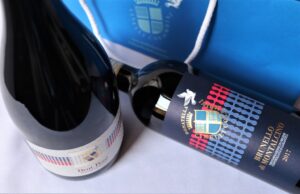
An elegant wooden box full of important bottles to celebrate the festivities: two Brunello Riserva 2012 and two Brunello Riserva 2013 and two bottles of Vin Santo 2008


FESTIVE SEASON WINE CRATE

FOR MEMBERS OF DONATELLA’S CLUB

SPECIAL PRICE of 329€ (instead of 380€)  including wooden crate and free shipping in Italy or with a 20,00 Euro discount abroad


FOR THOSE NOT YET MEMBERS OF DONATELLA’S CLUB

PRICE of 357€ (instead of 380€) including wooden crate and free shipping in Italy or 20,00 Euro discount for shipping abroad


HOW TO ORDER AND PAY

To order the wine send an email to vino@cinellicolombini.it
Payment via bank draft or Visa and MasterCard.

DURATION OF THE OFFER

This offer finishes on November 17th, 2020


Covid: wineries and restaurants, who wins and who loses

Wine sales grow but the financial reports of small wineries do not. Will Covid19 bring the small wine producers and restaurateurs to sell up to larger ones?


Restaurants-wine-and-covid-how-change-and which-are-the-new-perspectives

Restaurants-wine-and-covid-how-change-and which-are-the-new-perspectives

By Donatella Cinelli Colombini

There is a solution to the problem which I am about to address: transform restaurants into places where one can discover wine and food. Give new perspectives to the wine and food artisans of their territory. Is this a dream? No it is an opportunity for everybody.


HOW DOES WINE BUYING AND CONSUMPTION CHANGE WITH COVID

In US, the consumers buy more bottles (57%) and the large wineries earn bigger shares of the market at the expense of the smaller, which register a decrease in business.

Research done by the Sonoma State University and published by Wine Searcher regards the US, but in fact resembles greatly what I hear from Italian producers.

The analysis done in the US firstly emphasizes the increase in the price of wines bought by retailers. We are talking about only 0,70 Dollars, but in view of the general economic situation it is something noticeable. It  is also noticeable that the segment of the most sold bottles is that of those between 20 and 25$.

Consumers buy more expensive wines and the premium bottles move indoors? Maybe that is so.


Restaurants-wine-and-covid-how-change-and which-are-the-new-perspectives-Ravioli-stuffed-with-pecorino-cheese-and-LeoneRosso

Restaurants-wine-and-covid-how-change-and which-are-the-new-perspectives-Ravioli-stuffed-with-pecorino-cheese-and-LeoneRosso

ON LINE AND DELIVERY, THIS IS WHERE COVID HAS GIVEN A HAND

Wine ordered directly from wineries online has greatly increased. But the average price has decreased by 10$ with respect to last year and the bottles over 150$ have become unsellable. Another important element: small wineries have had difficulties also with this sales channel, and their stocks in the warehouses is increasing.

All leads to the impression that there will be acquisition by the large wine brands of great slices of the market, while small wineries struggle because of less visibility online and on store shelves.

According to experts, the Americans have had more economic availability during the pandemic maybe because they were forced to stay indoors. This situation has increased their shopping figures, and for some goods such as Champagne the prospect is of a particularly florid period. Less rosy are the perspectives for restaurants that will now have more difficulty in marking up wines  like they did before, because clients are now used to buying online and they know how much bottles cost.


Tuscan Onion Soup

There are two versions of the Tuscan onion soup. I prefer the one that comes from Arcidosso a sort of forefather of the “acqua cotta”, but of course there is also the Carabaccia


By Donatella Cinelli Colombini


It must be said the best Tuscan onion comes from Certaldo; it has a delicious taste and is more easily digestible with respect to normal onions. The Carabaccia is practically homage to the Certaldo onion but those of us from Montalcino are bonded to Monte Amiata, the volcano from which the soils in our vineyards come from. So the zuppa di cipolle from Arcidosso is my favourite. A medieval soup from which the acqua cotta soup descends. In the original version it is prepared with strigoli, a type of wild grass usually found in the chestnut woods on the Amiata but we will use the more domestic and easily found spinach.


INGREDIENTS FOR THE AMIATINA ONION SOUP

For 4 people


Ingredients-onion-soup-Fattoria-Del-Colle-Tuscany

Ingredients-onion-soup-Fattoria-Del-Colle-Tuscany

BROTH: one small onion, one carrot, one stick of celery, one ripe tomato, black pepper and salt


SOUP: 5 onions, one stick of celery, 500 g of spinach, 500 g of ripe tomatoes, extra virgin olive oil, 300 g of ricotta, salt, chili pepper, toasted unsalted bread.


PREPARATION OF THE AMIATINA ONION SOUP

Prepare the broth by putting in a pan, the washed and roughly diced celery, carrot, onion and tomato, covered with two litres of water. Salt and bring to the boil, simmer for a couple of hours over a low flame.
To prepare the soup: parboil and peel the tomatoes. Wash and chop the carrots, and onions, and celery and stir fry in a pan. Add salt and chili pepper. Wash the spinach and put them in the pan once the mixture is dry. Shortly after add the peeled tomatoes roughly chopped. Continue to cook over a low flame for about an hour, with the help of the vegetable broth.

Food and Travel Award

We are the winner!!!! Fattoria del Colle in Tuscany has received the   Food and Travel Award as country inn of the year 2020 on October 3nd at San Barbato Resort Spa&Golf


A great prize for  Fattoria del Colle from Food and Travel, an international magazine able to cater for the more demanding tourists and to help them discover the food and wine excellencies around the world.


FATTORIA DEL COLLE A PRIZE FOR THE MOST AUTHENTIC TUSCANY

Food-and-Travel-Award-2020-to-Fattoria-del-Colle-with-Violante-and-Enrico-receiving-the-prize

Food-and-Travel-Award-2020-to-Fattoria-del-Colle-with-Violante-and-Enrico-receiving-the-prize

The 2020 award as best Italian agriturismo rewards Donatella Cinelli Colombini’s choices in favour of the re-proposed “philological” of rural civilization. A choice that regards apartments furnished with antiques, the serving of traditional home made dishes in the restaurant, vegetables from the vegetable garden …  and the guided tours that teach Tuscan history or the nature trail to learn all the vine’s secrets. Fattoria del Colle has a soul and an authenticity that are very strong; they are the result of courageous and non conformist choices. This is what distinguishes the agriturismo awarded by Food and Travel, from resorts, where the renovations have adapted the original characters.

Donatella Cinelli Colombini, once ex art historian and today success wine producer has tenaciously wanted to transform Fattoria del Colle into a wine destination able to give touching and authentic experiences which impart to guests the true spirit of the Tuscan countryside. This ward states that she has succeeded.


THE VINEYARD’S DIET

Does the vineyard have “nutritional disorders” such as anorexia or bulimia? No, but it does have something similar and an Australian app helps grape growers keep it healthy


Vineyard's-nutrition-Montalcino-CasatoPrimeDonne

Vineyard’s nutrition – Montalcino – Casato Prime Donne

by Donatella Cinelli Colombini

I heard talk about the “humanized” approach for the first time in the  Bordeaux University, about twenty years ago, when the lesson regarding the summer pruning of the vine referred to “the vine sexuality”. In fact it did regard the intervention of man on the equilibrium between the grape grower’s project, who wants to produce grapes for wine, and that of the vine, who wants to reproduce itself.


THE AUSTRALIAN APPROACH TO THE VINEYARDS NUTRITION THROUGH ARTIFICIAL INTELLIGENCE

Suzy Rogiers - Vineyards nutrition and artificial intelligence

Suzy Rogiers – Vineyards nutrition and artificial intelligence

In this case the Wine Australia and the Charles Sturt University have gone even further and have forced the National Wine and Grape Industry Center (NWGIC) researchers to create an app for Smartphone to manage the vineyard’s nutritional disorders as if it were a human being. What is curious is that for both man and the vineyard the nutritional problems come from the wrong approach by “parents”. It seems a paradox but the Australian method to the managing of the vineyard helps us to rethink, in a more general way, all of our behaviours, in life like in the wine enterprises. Often grape growers in fact over feed their vines and they mistake the vigour for wellbeing of the plants, just like some mums fill their kids with love by piling their plate until they get obese.


Cinelli Colombini
Privacy Overview

This website uses cookies so that we can provide you with the best user experience possible. Cookie information is stored in your browser and performs functions such as recognising you when you return to our website and helping our team to understand which sections of the website you find most interesting and useful.