







NEWS AND EVENTS
Blog
VINEYARDS AT CASATO PRIME DONNE (2)
A TESTAMENT TO ENVIRONMENTAL COMMITMENT: ORGANIC FARMING THAT LEANS TOWARDS THE BIODYNAMIC REGIME, ALONGSIDE EFFORTS TO ENCOURAGE SANGIOVESE TO RESPOND ON ITS OWN TO CLIMATE CONDITIONS AND MOULDS.
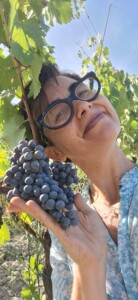
Violante Gardini Cinelli Colombini shows Sangiovese for Brunello Casato Prime Donne
By Donatella Cinelli Colombini, winedestination
Cultivation at both Casato Prime Donne and Fattoria del Colle is entirely organic and has been certified since 2018. Paradoxically, in fact, to display the “green leaf” symbol, one must pay an external company to conduct inspections. Organic farming is a cultivation system that uses fewer chemicals than conventional methods, but—naturally—that alone is not enough; consequently, we adopt many practices from biodynamics. In summer, for instance, we use clays—specifically kaolin—to shield leaves and grape clusters from the sun. At other times, we use products derived from oranges, seaweed, and even propolis.
To combat certain pests, like spider mites, we buy predators from bio-factories. The first time I received the box containing the little bags of predators, I was afraid—thinking, “Watch, these things are going to jump on me”—but then I saw that they have no interest in humans. In some cases, such as with the vine moth, there is a mating disruption system that prevents them from reproducing… It’s a dirty trick to play on these insects, but for them, it’s better than insecticide.
MUCH MORE THAN ORGANIC
Our fertilizers are natural, too; however, after years of using mature organic manure, we switched to pelleted organic fertilizer. Although it costs more, it doesn’t cause grass to overrun the vineyards, leaving us free to decide exactly what grows beneath the vines. In the vineyard, it is essential to avoid anything that competes with the vines for water or grows so vigorously that it creates a damp environment conducive to mold. In winter, we sow a plant mix—or legumes, specifically field beans. This cover crop is subsequently tilled into the soil to make it lively, fertile, and loose.
Weather stations provide significant help in reducing chemical use in the vineyard by monitoring rainfall, wind, and temperatures, as well as other seemingly minor factors—such as the temperature 30 cm underground.
FROM WINE BY THE GLASS TO OXIDIZED WINE
CUSTOMERS ARE INCREASINGLY ORDERING WINE BY THE GLASS INSTEAD OF BOTTLES, BUT WHAT THEY GET IN THEIR GLASS IS SOMETIMES OXIDIZED. HOW TO UNDERSTAND IT AND WHAT TO DO
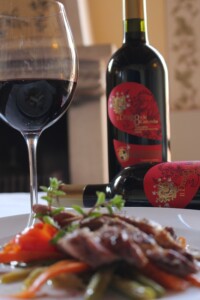
>Wine by the glass and oxidized wine Tagliata di cinta senese – Fattoria del Colle Trequanda Toscana
By Donatella Cinelli Colombini, winedestination, Fattoria del Colle Trequanda, Casato Prime Donne Montalcino
I order wine by the glass, especially if it’s an opportunity to try new things and share a glass with friends. However, restaurants often aren’t equipped for this type of service. They don’t have nitrogen systems or even oxygen extraction pumps. You might see bottles served by the glass displayed on the counter, corked, with the original cork, so besides being too warm, they’re almost certainly oxidized.
WINE BY THE GLASS IS ATTRACTIVE, BUT YOU NEED TO KNOW HOW TO CHOOSE AND STORE IT
At a certain point, it’s worth making a sacrifice and ordering a whole bottle, hoping the manager will have a bag to take it home and finish it at leisure.
And yet, wine by the glass is on the rise. Many, like Andrea Gori, believe it is the best way to stem the decline in consumption. And, all things considered, it’s also very profitable for restaurants and wine shops. For still wines, a bottle is good for five glasses, and by the third glass, the manager has already pocketed the full retail price. Obviously, this is possible if the service is intelligent, offering the right wines: established brands alongside authentic rarities waiting to be discovered, but above all if the storage equipment is adequate.
VINEYARDS AT CASATO PRIME DONNE (1)
THE SECRETS OF GREAT VITICULTURE, DRAWN FROM THE FIRSTHAND EXPERIENCE OF A PRODUCER CRAFTING AN EXCEPTIONAL BRUNELLO BY LETTING THE GRAPES DO THE WORK- EVEN AS THE CLIMATE CHANGES
Sangiovese for Brunello Donatella Cinelli Colombini Casato Prime Donne Montalcino vineyards
By Donatella Cinelli Colombini, winedestination
I began managing the vineyards at Fattoria del Colle in Trequanda and Casato Prime Donne in Montalcino in 1998, when my parents gifted me the two estates.
Across the two properties, there were about 25 hectares of old vineyards featuring many dead vines (gaps in the rows) and a multitude of grape varieties and Sangiovese clones—all mixed together and often of poor quality. Unfortunately, it is impossible to restore vineyards in such a state, so I had to uproot and replant them.
I adore centenarian vineyards and envy those who own them. The only old vineyard I managed to save is Sant’Antonio, planted in 1987; it is treated like a relic and tended to with great care… yet it is only forty years old.
I HAVE BEEN PLANTING VINEYARDS FOR 25 YEARS IN THE “GOLDEN CUP” OF BRUNELLO
The remaining vineyards at Casato Prime Donne have been replanted between 2000 and the present day. This process was carried out gradually—planting one or two hectares a year—and relied on a team of excellent vineyard workers led by two extraordinary, passionate “vignerons”: Efisio Luche and Davide Rinaldi. I recall that in 2015, when Denis Dubourdieu—the renowned and formidable professor from the University of Bordeaux’s oenology department—visited us and walked through every single vineyard, he said to Efisio: “Félicitations, vos vignobles sont impeccables.”
Casato Prime Donne is located in the northern Brunello zone, atop a 225-meter hill formed by the fragmentation of the larger Montalcino hill—a process that created the Montosoli rise and, right next to it, our own. In front lies a small valley carved by the Suga stream, which may well have been a river millions of years ago. It is a stunning, cup-shaped area that turns golden yellow after the harvest, thanks to the Sangiovese leaves—a landscape we might well call the “golden cup.”
RED WINE SERVED CHILLED IS BETTER
I ONCE SERVED MY BRUNELLO AT THE TEMPERATURE OF A HOT BROTH, AND I WAS MORTIFIED. YOU NEED TO USE AND ICE BUCKET FOR REDS TOO

Tormaresca Antinori -fichimori- red wine to be served chilled
by Donatella Cinelli Colombini, winedestination, Fattoria del Colle Trequanda, Casato Prime Donne Montalcino
Until a few years ago, the problem for us Brunello producers was bottles getting too cold in winter; however, global warming has reversed the situation. Now, the focus is on cooling the wine, as no one wants to serve it at a temperature that makes it resemble herbal tea. That is why using ice buckets—a practice once reserved for whites and rosés—has become common for reds as well. And I am not referring only to young wines that emphasize freshness, but also to great reds meant for aging.
RENOWNED SOMMELIERS AND WINEMAKERS ALIKE AGREE ON THE PRACTICE OF CHILLING WINES
A delightful article by WineNews discusses this trend, featuring insights from prestigious sommeliers such as Paolo Porfidio (Excelsior Hotel Gallia, Milan), Sebastien Ferrara (Enrico Bartolini al Mudec, Milan), and Marco Reitano (La Pergola by Heinz Beck, Rome).
SANDRA MISALE PRIMA DONNA 2026
SANDRA MISALE RANKS AMONG THE WORLD’S LEADING CANCER RESEARCHERS. JOURNALISTS FRANCESCA CIANCIO AND ANDREA CUOMO, ALONG WITH 9 YOUNG TALENTS, WERE ALSO HONORED ALONGSIDE HER

Francesca Ciancio winner of the Casato Prime Donne Award 2026 journalistic section
In Montalcino, on Saturday, September 19, the Casato Prime Donne Award honours Sandra Misale—a 41-year-old woman born in Calabria who now heads a laboratory bearing her name at Johns Hopkins University in Baltimore. If patients suffering from pancreatic or colon cancer, melanoma, or leukaemia can today hope for a more effective and less invasive treatment, they owe it in part to her.
The jury of the Casato Prime Donne Award—chaired by Donatella Cinelli Colombini and comprising Rosy Bindi, Anselma Dell’Olio, Anna Pesenti, Stefania Rossini, Anna Scafuri, and Daniela Viglione—selected Francesca Ciancio and Andrea Cuomo as the winners in the journalism categories for promoting Montalcino and its wines. Other awards went to nine young talents in the fields of music, art, jewellery making, and pastry arts.
CASATO PRIME DONNE A BRUNELLO WINERY AND MUCH MORE (2)
THE ARTWORKS AND DEDICATIONS ALONG THE PRIME DONNE TRAIL TRANSFORM THE WINERY VISIT AND VINEYARD TREK INTO AN ENRICHING AND REJUVENATING EXPERIENCE
By Donatella Cinelli Colombini, winedestination, Fattoria del Colle Trequanda, Casato Prime Donne Montalcino
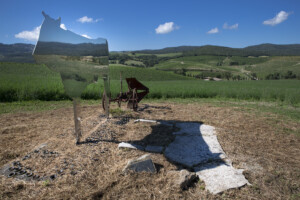
Montalcino -Casato Prime Donne 2012 ARDITA
2012 “ARDITA” BY MARCO PIGNATTAI
Ardita depicts a life-sized Chianina ox—a historic animal of this land, where it once toiled pulling the very same plough the artist has placed behind the sculpture. The ox is crafted from a mirrored steel silhouette that reflects the surrounding countryside, appearing almost to become part of it. It stands beside the vineyard of the same name, on the hill overlooking Casato Prime Donne.
In 2005, the young architect Marco Pignattai—a native of Montalcino—designed the first Chianina ox, which was created from travertine, a stone typical of the Siena area. As is often the case with Land Art, the installation became part of the natural environment, shifting with the changing seasons and times of day… it became covered in moss and eventually collapsed to the ground, destroyed by the elements. Today, the original Ardita lies on the ground like a shadow of its twin—the one installed in its place—which is even capable of visually incorporating the original into its own image.
The quotation by Maria Carmela Lanzetta, Mayor of Monasterace, who defied the ‘Ndrangheta:
“Our eyes, dazzled by the colours of the sea in our native town and by the cypresses sailing upon the harmonious waves of the Tuscan hills. To journey through that endless vista while reflecting on the beauty of the landscape—which must be preserved—and on the women who must be protected from daily violence.”
CASATO PRIME DONNE: A BRUNELLO WINERY—AND MUCH MORE (1)
IF YOU ARE LOOKING FOR A WINERY THAT WILL SURPRISE YOU, COME TO CASATO PRIME DONNE. HERE, I WILL TELL YOU WHAT AWAITS YOU—BEYOND EXCEPTIONAL BRUNELLOS AND UNIQUE EXPERIENCES.
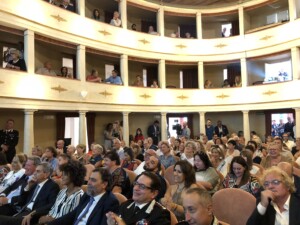
Montalcino 2018 Casato Prime Donne Award with winner Sara Gama
By Donatella Cinelli Colombini, winedestinations, Fattoria del Colle Trequanda, Casato Prime Donne Montalcino
There is a common belief that all wineries are alike. To some extent, this is true, as many do resemble one another; after all, the types of barrels and fermentation tanks used are much the same everywhere. Consequently, architects have sought to arrange them aesthetically to create a “wow factor,” even though this often comes at the expense of winemaking itself. While a uniform row of identical vats may look more harmonious, it is rarely practical to have identical quantities of grapes to fill them. In most cases, winemaking vessels of varying sizes are required to keep grapes from different vineyards, grape varieties, and stages of ripeness separate.
WHAT TOURISTS DON’T EXPECT AT FATTORIA DEL COLLE (2)
FEW COUNTRY ESTATES BOAST A HISTORY AS ANCIENT, NOBLE, AND ENTERTAINING AS FATTORIA DEL COLLE – AND TOURISTS GET TO LIVE RIGHT IN THE MIDST OF IT.
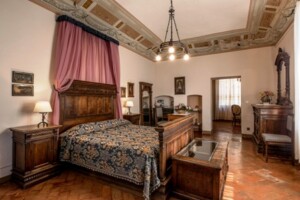
Toscana agriturismo Fattoria del Colle Grand Duke’s chamber
by Donatella Cinelli Colombini, winedestination, Fattoria del Colle Trequanda, Casato Prime Donne Montalcino
Let us continue sharing the little secrets of Fattoria del Colle that surprise and delight tourists—the details that make a stay there unique, distinctive, and memorable.
The villa’s historic rooms and its chapel house true art masterpieces. The owner, Donatella Cinelli Colombini, is an art historian by background and spent years specializing in medieval goldsmithing. She owns just one piece created by 15th-century Sienese goldsmiths: a copper processional cross. The other artworks are casually interspersed with everyday objects throughout the historic rooms of the villa, where she still resides. Donatella has always lived surrounded by masterpieces; she has no desire to put them on display, preferring simply to enjoy their presence around her. Nevertheless, she is well aware of the risks posed by frequent tourist visits and the threat of theft, which is why Fattoria del Colle is protected by security cameras and alarm systems.
The Hall of Coats of Arms, the billiard room, and the fireplace room retain some of their original furnishings and house many curiosities—such as the list of chickens, brooms, and eggs that each farmstead was required to supply, the alarm bell cord hidden inside the clock, and antique white porcelain from Richard (the company that later became Richard Ginori).
WHAT TOURISTS DON’T EXPECT AT FATTORIA DEL COLLE (1)
THE SECRET ROOMS AT FATTORIA DEL COLLE WINERY AND THE STORY OF THEIR SURPRISING DISCOVERY. WHY THIS IS A UNIQUE PLACE WHERE HISTORY BECOMES WINE
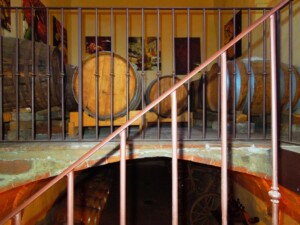
Toscana Vin Santo Fattoria_del_Colle_vinsantaia
By Donatella Cinelli Colombini, winedestination, Fattoria del Colle Trequanda, Casato Prime Donne Montalcino
First-time visitors to Fattoria del Colle often say, “It’s beautiful here—I wasn’t expecting this.” They are delighted to find themselves in a genuine, significant place that is nonetheless unpretentious and welcoming. It is a unique setting that moves them, allowing them to experience the Tuscan countryside in all its simplicity as well as its extraordinary, historic beauty.
Yet we are amazed by their amazement. All our communication is completely authentic; we take photos or videos almost every day, and our social media followers see exactly what is going on—without filters, without staging, and without even rearranging objects or furniture. That is simply who we are, and yet tourists are surprised when they arrive. Perhaps we don’t know how to take photos. Or maybe the habit of presenting an idealized image online—better than reality—is so widespread that encountering people like us, who show themselves exactly as they are, comes as a surprise.
DONATELLA BEGINS WORKING AT FATTORIA DEI BARBI
PECORINO CHEESE, CURED MEATS, HOSPITALITY AND PUBLIC RELATIONS – THIS IS HOW DONATELLA’S PROFESSIONAL CAREER BEGAN, A TIME DURING WHICH SHE ALSO BECAME MOTHER WITH THE ARRIVAL OF VIOLANTE
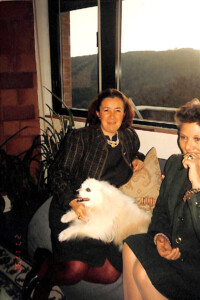
Donatella at Fattoria dei Barbi
By Donatella Cinelli Colombini, winedestination, Fattoria del Colle Trequanda, Casato Prime Donne Montalcino
DONATELLA BEGINS WORKING AT FATTORIA DEI BARBI
Tired of playing the role of the supportive wife and doing the cooking, I decided to ask my mother, Francesca, if I could work for the family business; she assigned me the task of managing the dairy, the cured meats production, the restaurant, inbound tourism, and media relations.
Meanwhile, our daughter Violante was on the way. There hadn’t really been a conscious decision to have a baby, either. My husband, Carlo, kept putting it off because he didn’t want to change our life as a couple, but then we went to Mexico; I caught “Montezuma’s Revenge”—traveller’s diarrhoea—which shifted my cycle, and I ended up pregnant. After a perfect pregnancy, Violante was born in the small hospital in Montalcino. She is the only member of the family born in the land of Brunello.
I arrived at the hospital at eight o’clock, and half an hour later, Violante was born. While most newborns are wrinkled, she was so beautiful she looked almost unreal. At first, she just ate and slept, but then our nights became a nightmare. When she finally slept for eight hours straight at the age of two, Carlo and I rushed to her crib to see what had happened. It was an experience that sealed our decision to let her remain an only child.
DONATELLA AS A CHILD
I WAS A LONER, A TERRIBLE STUDENT, AND AN AVID READER. I WITNESSED THE TUSCAN COUNTRYSIDE TRANSFORM FROM A STATE OF ABANDONMENT TO A RENAISSANCE DRIVEN BY WINE AND TOURISM
by Donatella Cinelli Colombini, winedestination, Fattoria del Colle Trequanda, Casato Prime Donne Montalcino
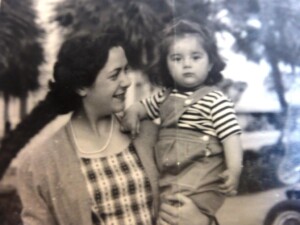
Donatella and her mother Francesca Colombini
Many refer to the twentieth century as the “Short Century”—a term coined by British historian Eric Hobsbawm—due to the rapid pace of change; yet, in the early 1960s, it felt as though one were living in a nineteenth-century bubble. It was a world precariously balanced between the lingering past, the economic boom that was emptying the countryside, and social rituals that seemed destined to last forever—only to be swept away by the events of 1968.
As a young girl, I used to spend summers in Montalcino playing with the children of the neighbouring farmers, who would run around barefoot. In winter, back in Florence, boys and girls attended separate classes at the Ponte a Mensola elementary school; we girls wore white smocks with pink bows at our collars. Traffic and crime were low, and we children would walk home alone.
DONATELLA’S HOUSE IN GOZO
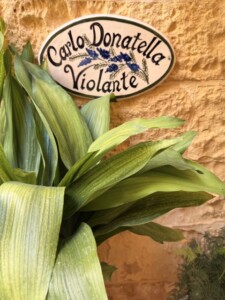
Donatella Cinelli Colombini’s hose in gozo, Malta
AN OLD STONE HOUSE WITH A BREATHTAKING VIEW OF MALTA AND AN INDOOR COURTYARD FOR DONATELLA’S HOLIDAYS. LOTS OF TRADITION, BUT ALSO WIFI AND AIR CONDITIONING.
by Donatella Cinelli Colombini, winedestination, Fattoria del Colle Trequanda, Casato Prime Donne Montalcino
Donatella’s house in Gozo boasts a breathtaking view of the strait that separates the island from Malta. This stretch of sea is frequented by ferries, cruise ships, fishermen, and yachts… sailing around the small island of Comino, with its romantic blue lagoon and the tower where The Count of Monte Cristo was filmed.
FATTORIA DEL COLLE’S WEDDINGS IN 2026
ONLY VERY LARGE AND TRADITIONAL PLACES ALLOW COUPLES TO HAVE A UNIQUE WEDDING, DIFFERENT FROM ALL OTHERS, FULL OF ROMANCE AND BEAUTY.
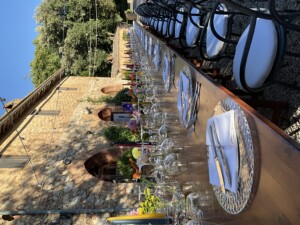
Pizza party at Fattoria del Colle-Tuscan style wedding
By Donatella Cinelli Colombini, winedestination, Fattoria del Colle Trequanda, Casato Prime Donne Montalcino
This year, Fattoria del Colle is hosting 17 weddings, all different and all beautiful.
Some are minimalist, others boasted spectacular floral arrangements and displays.
We’ve had couples with photographers and set designers, Instagrammers, videographers, and a whole repertoire of sun glasses, dresses, and decorations to create images to post online. Others asked for absolute privacy, even from their guests, to preserve the intimacy of the most beautiful day of their love.
WHY WEDDINGS AT FATTORIA DEL COLLE ARE ALL UNIQUE AND DIFFERENT
There are many ways to organize your wedding in a large venue with diverse and evocative spaces for the ceremony, aperitifs, dinner, cake cutting, and the closing party. At Fattoria del Colle, all couples have left happy and feeling like they’ve experienced a unique moment, uniquely theirs and unlike any other.
Of course, there are some places no one wants to miss out on, like the panoramic terrace above the winery. The Corten railing, reminiscent of the oak trees of the Val d’Orcia, frames a landscape of extraordinary beauty, and all newlyweds choose it for the ceremony or aperitifs. Another must-have, no one wants to miss out on, is the barn, restored a few years ago. The large windows feature state-of-the-art glass that keeps out sound, so you can dance until the wee hours without disturbing anyone. The light fountains, the harmonious architecture, the bar tender counter and the perfect air conditioning complete a very Tuscan atmosphere but perfect for parties.